The price of crude instantly tumbled on Tuesday after the Trump administration is reportedly considering providing, or assisting in obtaining insurance for oil tankers crossing through the strait of Hormuz.

According to Reuters, "U.S. President Donald Trump will review policy options on Tuesday aimed at controlling energy prices following recent attacks linked to Iran, including a proposal to help oil tankers transiting conflict zones to obtain insurance, according to two sources familiar with the matter."
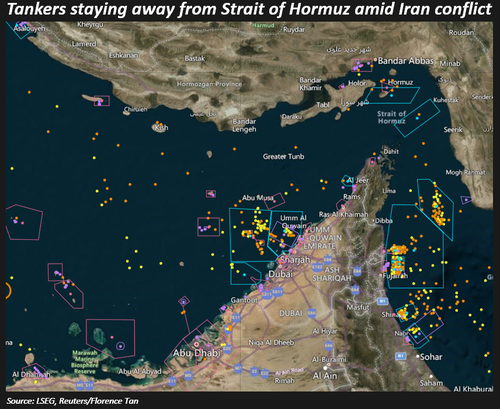
Ships have been frozen on either side of the strait after insurers instituted "war policies" that wouldn't pay out.
Supertanker costs in the Middle East have hit all-time highs, according to shipping data and industry sources on Tuesday, as the U.S.-Iran conflict intensifies with Tehran attacking ships passing through the Strait of Hormuz.

The immediate reaction was a plunge in crude prices...

And as we suggested earlier today...
The news comes after the commander of Iran's Revolutionary Guards said that the strait of Hormuz is closed and that Iran would target any ship trying to pass through.
If President Trump were to provide U.S. Treasury-backed war-risk insurance or direct naval assistance to oil tankers transiting the Strait of Hormuz, it would amount to a modernized fusion of the Carter Doctrine with Trump-style economic statecraft. In 1980, Jimmy Carter declared the Persian Gulf a vital U.S. interest and pledged to use “any means necessary” - up to and including the use of military force - to prevent outside powers from controlling it. That doctrine institutionalized a permanent American security guarantee over Gulf energy flows, eventually embodied in the creation of United States Central Command and the U.S. naval presence that still patrols the region. Its core premise was simple: energy security is national security.
A Trump-era move to insure or financially backstop tanker traffic through Hormuz would preserve that core premise but update the mechanism. While the exact details of the insurance proposal are unknown - rather than relying solely on overt military escalation to reopen the strait, Washington could absorb shipping risk, stabilize insurance markets, and allow tankers to sail under U.S. guarantees - with naval force as a backstop rather than the opening move. In effect, it would convert a military red line into a market-stability red line. Iran’s leverage depends on panic: if oil spikes toward $100–$120 because traffic halts for weeks, global recession pressure mounts. But if the U.S. neutralizes that panic through financial guarantees and controlled deterrence, the chokepoint loses much of its coercive power.
The result would be a hybrid doctrine: Carter’s hard-power commitment to freedom of navigation combined with Trump’s preference for leverage, economic tools, and time-bound pressure rather than open-ended intervention. It would signal that the United States will not allow the weaponization of energy chokepoints - not just through force, but through balance-sheet power.
Developing...
Loading recommendations...