Authored by Eva Fu via The Epoch Times (emphasis ours),
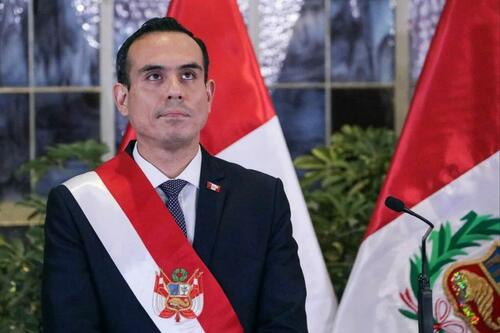
The ouster of Peru’s president began with a secret late-night dinner. A series of clandestine encounters followed—dark glasses at one meeting, a hood over his face at another.

Then videos leaked. Amid a nationwide uproar, three-quarters of Peru’s lawmakers voted to censure the initially popular José Jerí, just four months into his presidency. He was the country’s seventh leader in 10 years.
“We ask to end this agony so we can truly create the transition citizens are hoping for,” said Ruth Luque, one of 75 lawmakers who voted to oust Jerí. “Not a transition with hidden interests, influence-peddling, secret meetings, and hooded figures. We don’t want that sort of transition.”
The man meeting with Jerí was Chinese restaurant and wholesale store owner Yang Zhihua, who is behind several major Chinese infrastructure deals in the country.
Dubbed “Chifagate,” a nod to fusion Peruvian-Chinese cuisine, the scandal has thrown another wrinkle into an already strained relationship between the two countries.
Currently, Lima is fighting to regain oversight over a major China-controlled port at Chancay, which has become a symbol of China’s footprint in Latin America.
Across the region, a deeply entrenched web of Chinese influence is enabling the communist regime to redefine dynamics in America’s backyard.
Starting with near-negligible investment levels in 2000, China has become a dominant force in Latin America and the Caribbean, with trade exceeding $500 billion in 2024. For many individual nations, such as Brazil and Peru, China has overtaken the United States as a key trading partner.

Along the way, Beijing has built enormous leverage, said Ding Hung-bin, associate dean at Loyola University Maryland’s Sellinger School of Business and Management.
“The Chinese Communist Party is playing the long game in Latin America,” he told The Epoch Times.
With the money pouring in, Ding said, Beijing reaps political influence, biding its time to challenge the U.S.-led world order. After two decades, he said, “the fire has reached the U.S. doorstep.”
Washington is now making clear that this can’t continue. In its national security strategy released in November, the Trump administration made the region its top priority, describing a “great American strategic mistake of recent decades” in allowing “non-Hemispheric competitors” to take hold in the Western Hemisphere.
The past inaction, the document reads, has cost the United States both “economically in the present” and “strategically in the future.”
Within weeks of the strategy being released, U.S. forces captured Venezuelan leader Nicolás Maduro and brought that country’s courtship with China to a halt.
Just hours before his capture, Maduro hosted a Chinese envoy at the presidential palace. He accepted a porcelain vase and posed for photos with the Chinese delegates, then proclaimed on social media that the meeting reaffirmed the two countries’ “strong bonds of brotherhood” through “thick and thin.”

The Digital Silk Road
The “brotherhood” is Beijing’s lever.
In September, Maduro proudly showed off a foldable red-colored Huawei phone that he used daily—a gift from Chinese leader Xi Jinping.
Maduro hailed it as the “best phone in the world.”
“Americans can’t hack it,” he told reporters.
To China, it was a validating moment in the regime’s battle for technological supremacy, with Huawei leading the way.
Blacklisted in the United States, the Chinese telecom provider has been deepening its foothold in other parts of the Americas. It spearheads the Digital Silk Road, a core element of Beijing’s trillion-dollar Belt and Road Initiative aimed at stretching the regime’s power and influence around the globe.
Huawei’s data storage platform now covers every Latin American country, boasting the fastest business growth among telecoms. The significance of that sank in when Brazil sought to block Huawei from its 5G networks on national security grounds in 2020. Huawei’s technology was already embedded in the country’s telecom architecture; replacing it would have cost billions of dollars.

In 2022, Huawei signed a deal to turn Curitiba in southern Brazil into a 5G-powered smart city, integrating artificial intelligence and big data into urban life, from medical surgeries to public security. Its website now features an interview with the city’s mayor, who touted Curitiba as a “smart city that works for its citizens.”
And Huawei isn’t the only Chinese entity expanding in the region. Market research data from Canalys show that Chinese phone brands now command more than 60 percent of the Latin American market.
In Ecuador, the China-made ECU911 system powers up surveillance cameras nationwide that feed real-time footage to a thousands-strong police unit, which deals with everything from traffic to national security. Touting its scale of impact, Xi once called it a “calling card for China–Latin America’s high tech collaboration.”
By law, Chinese companies have no choice but to hand over whatever they have if the Chinese Communist Party asks. And that makes their ubiquitousness problematic, said Evan Ellis, Latin American studies research professor at the U.S. Army War College Strategic Studies Institute.
With all the data coming out of corporate boardrooms, factory floors, and people’s homes, the key question is where they get offloaded, he told The Epoch Times. Chinese technologies’ presence in federal agencies across the region, he said, “opens up government officials to blackmail.”
‘Predatory’ Investments
Beijing has a phrase for its vision: the “China–Latin America community with a shared future.”
Xi was the first to evoke the term. Addressing Brazil’s National Congress in 2014, he compared the China–Latin America relationship with wine—something that “grows better as it ages.”
The idea here is to “rebuild from the roots, pulling the 33 Latin America and Caribbean nations together with China while keeping America out,” Florencia Huang, a professor specializing in Latin American studies at Taiwan’s Tamkang University, told The Epoch Times.
Under that banner, China attracted more than 20 Latin American and Caribbean countries to join the Belt and Road partnerships. Hundreds of infrastructure projects followed.
Chancay Port, a $1.3 billion project nearly 50 miles from Lima, is at the top of that list. The deepwater port, covering about 445 acres of Peruvian territory, is the primary Chinese logistics hub on the Pacific side of Latin America. Its strategic positioning directly links South America to China, cutting shipping time by nearly half while facilitating Beijing’s access to minerals critical to its industrial demand.
Chinese shipping giant COSCO has 30 years of exclusive operating rights to the port. The Peruvian port authority blamed this on an “administrative error” in 2024. But its bid to void the terms quickly fizzled out; the country’s congress approved changes that legalized the COSCO deal.
In a further win for COSCO, a Peruvian court on Jan. 29 restricted state oversight of the terminal’s operations. The United States warned that Peru could lose sovereignty of “critical infrastructure in its own territory” to “predatory Chinese owners.”
“Let this be a cautionary tale for the region and the world: cheap Chinese money costs sovereignty,” the State Department’s Bureau of Western Hemisphere Affairs wrote in a February statement.

“Predatory” is also what Ellis calls development projects such as Chancay, one of around 40 ports with Chinese investment in Latin America. Similar Chinese dominance repeats in sectors such as critical mineral extraction, logistics, and renewable energy.
A common pattern here, according to Ellis, is to first secure market access in strategic sectors, then control the supply chain.
“If you want access to the cheapest, fastest route, you need to cooperate with the Chinese,” Ellis said. “It gives them leverage.”
Then little by little, he said, they can push other shipping alliances out of business and capture the most important trans-Pacific routes for themselves.
As a state-owned enterprise, COSCO has worked closely with the People’s Liberation Army (PLA), providing logistical support in both Lebanon and Yemen in the 2010s.
In the event of a military crisis—say a conflict with the United States in the Indo-Pacific—COSCO’s officials would “use their exclusive control over that port in any way they could to resupply PLA warships,” said Ellis.
The Epoch Times has contacted COSCO for comment.

A Broad Fishing Net
In the heart of Argentina’s Patagonian desert, behind an eight-foot barbed-wire fence, a Chinese entity subordinate to the PLA’s strategic support force runs a seclusive space station. Access to outsiders is by appointment only.
Within roughly 100 miles south of the Florida shore, four strategically located Cuban sites alleged to have ties with China hold antennas and other gear that can collect intelligence on the United States, according to satellite imagery analysis. Of them, at least one underwent new upgrades in 2025 that could significantly enhance its surveillance capabilities, the Center for Strategic and International Studies said.
Covert intelligence gathering and dual-use facilities are far from the sole avenues for China in building an edge. More prominent—and apparently successful—are the regime’s broad overtures to foster ties on a personal level.
China’s senior military leaders have visited the region hundreds of times in the past two decades, according to the U.S.-China Economic and Security Review Commission. Concurrent with these activities were a stream of military exchanges, joint drills, and arms sales.

Beijing also heaped on incentives, offering Latin American military officers free training, business-class travel, and five-star hotel stays in China, the RAND think tank wrote in a 2022 Pentagon-sponsored research.
Through a state-directed program called “Bridge of the Future,” Beijing brought more than 1,000 Latin political dignitaries and “young leaders” on China trips, Chinese government records show.
Wang Yi, Chinese foreign minister, said in May 2025 that Beijing intended to invite 300 Latin American delegates in each of the following three years.
And such efforts have paid off.
A Honduran congressional staffer, during a 2023 trip to a Party “red tourism” village, gushed to Chinese state media about China’s poverty alleviation campaign, saying the regime had created a “miracle in human history.”
Other testimonials from Latin American officials abound, with an Argentinian colonel praising the Belt and Road Initiative and a major general crediting the regime’s COVID-19 control measures with “buying the West time.”
For a clue as to how much the regime values these programs, look no further than the Chinese white paper that dovetailed the U.S. National Security Strategy. Reading the document, Ellis said it amazed him “how many different programs there are for people at all levels.”
“The Chinese cast their fishing nets very broadly,” he said.
Read the rest here...
Loading recommendations...