Reminds me of Titius–Bode law[1], where simple equation correctly gave orbits of all the known planets, while predicting one more in asteroid belt and correct distance to Uranus. Only was considered disproven when Neptune didn't work.
I would not trust these relations even existing (other than by pure chance). Even less I'd trust any intelligent design behind it
I thought that, absent perturbation, accretion rings and planets would form at mathematical intervals due to orbital resonance effects. It’s just a very low energy state. Similar to how vibrational modes tend to be integer harmonics (actual overtone patterns are not perfect integer harmonics due to nonlinearities).
If I use classical language, this is the claim that there are harmonies in math itself that manifest as harmonies in the physical cosmos [1]. Arguably, it’s more weird that we don’t see more physical harmonies — it seems this is due to the incredible complexity of the nonlinear interactions.
That law reads like a good starting point for the lifetime evolution of matter around a star, but too simple to be expected to capture the full range of possibilities. Probably shouldn’t be used to refute hypotheses.
Barring intelligent design, there's an extremely good chance that at least one of these systems exist, and an equally good chance that only one exists, and we're just lucky enough to have observed it.
It depends on what priors you put on things like planetary size and orbital periods. If your prior is uniform, then it is just as likely for this configuration to exist as any other and because the probability mass is uniformly distributed (e.g. every outcome is equally likely) then there's probably only one of it.
Throw a d6 seven times and the pigeonhole principle requires that a configuration will come up twice. The example is weakening your argument; it's still true that if you throw a d6 five times, you expect a configuration to come up twice.
A better example wouldn't involve a probability that can achieve 1; maybe ask about the probability of rolling a 3, or of rolling another 3 given you've already observed one 3.
None of those will match the comment above; it isn't well posed.
> Throw a d6 seven times and the pigeonhole principle requires that a configuration will come up twice. The example is weakening your argument; it's still true that if you throw a d6 five times, you expect a configuration to come up twice
Even that isn't as strong as you could make it; rolling a die 5 times is basically the birthday paradox but instead of asking 30 people their birthdays to find a duplicate, you're asking 300.
In the case of life supporting planets though, it feels like we're trying to talk about the likelihood of rolling a given value when we haven't even determined whether the die has unique values on each face or not. If you're assuming that only one of the sides has a 3 on it, the interesting part is already over.
Yes, I mentioned that in my comment, unless you believe that after seeing five rolls including a duplicate, adding a sixth might bring the total to six rolls with no duplicates.
And with mathematically significant orbits, there is also the chance that some process stabilises to them which increases the chance of seeing them significantly. It is like being impressed by fractal designs in plants. The plant isn't intelligent and doesn't know about fractals, it is just that repeating patterns are easier for evolution to stabilise on.
But hey, if the job is staring at planets they may as well stare at these interesting planets.
The non-clickbait studies suggest that this is expected with planet formation.
What makes this one unique is that it seems to have avoided disruptive events. Intelligent design and aliens get the pop science web hits while unperturbed defaults do not.
"The current delicate configuration of the
planetary orbits in HD 110067 rules out any violent event over the billion-year history
...making it a rare “fossil” to study migration mechanisms and
the properties of its protoplanetary disk in a pristine environment."
"Consider the three largest moons of Jupyter. Europa takes exactly twice as long as IO to orbit Jupyter, and Ganymede takes exactly twice as long as that. How can that be? This is an example of synchronization, but what's the mechanism? That's what this video is about: it's an explanation of something called orbital resonance."
It's an equilibrium effect that occurs with at least one body is in an elliptical orbit. In this case it causes all the rubble particles to make their way towards the line of elliptical symmetry, but since its loose rubble (i.e. not enough gravity to maintain its shape), the individual rocks knock each other out of orbit. This is discussed in the video.
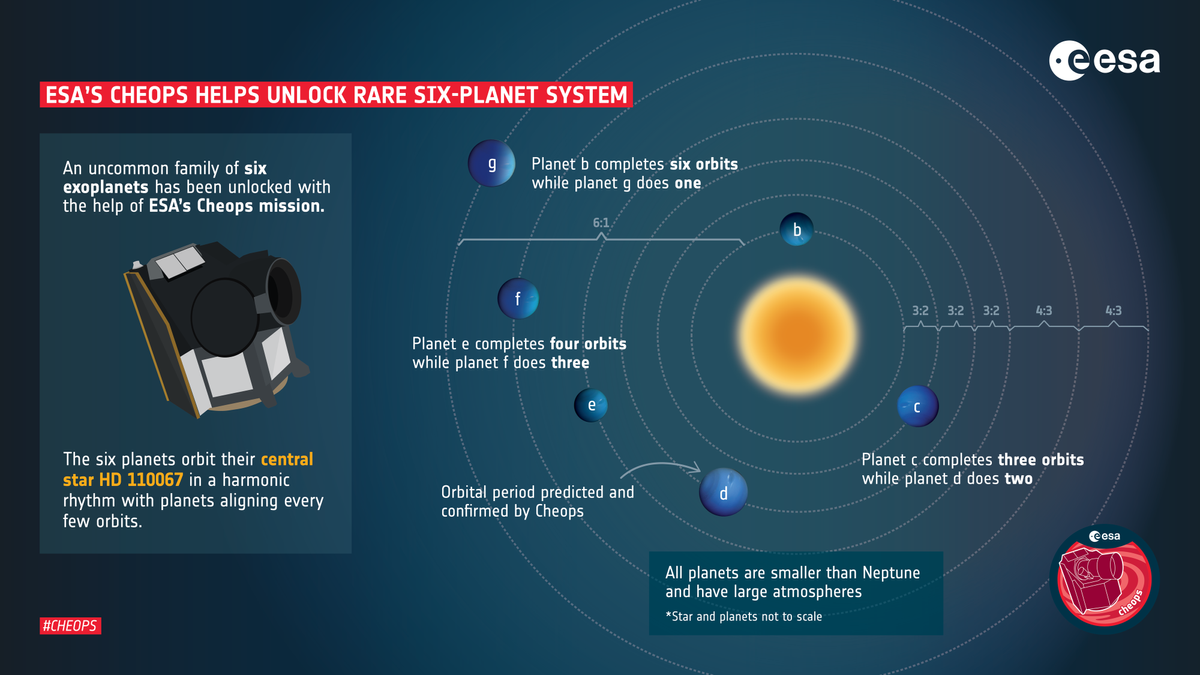
As detailed in the companion article [1], for every 54 orbits of planet 1, planets 2..6 orbit 36, 24, 16, 12, and 8 times respectively, giving successive ratios of 2/3, 2/3, 2/3, 3/4 and 3/4. After those 54 planet 1 orbits, all planets are in the same relative position.
It's mentioned in the preceding article and the two papers that are linked.
In spite of the title no one is wondering if aliens moved planets around to park them in special orbits. It's infinitely more likely the resonances developed naturally.
Also, none of the planets are in the habitable zone, so it's unlikely there's life on them.
Which is a shame, because if the star was much dimmer and they were in the habitable zone, the views would make a stunning tourist attraction.
I’m getting the sense they can be too close to form life, but can form further out with the right planetary characteristics. How often favorable atmospheres form would be interesting.
Taken another way: Venus’ atmosphere would get more “tame” further out. That might make it more conducive to life. But would its atmosphere still form at those distances? (Clearly it’s not impossible.)
The article seemed to imply such a system may be interesting as a "communication relay" for extraterrestrial civilizations. No matter what the system may attract anyone's attention
It is not at all clear to me why the harmonics makes it any more worth searching for aliens than any other solar system. a) Why would aliens expend the enormous energy required to engineer this? b) Isn't it vastly more likely to occur naturally as some sort of resonance effect?
"Why would aliens expend the enormous energy required to engineer this" Is a very similar answer to why humans would make microprocessors out of logic gates.
I'm in school for digital design at the moment, and stuff like oscillators and frequency dividers are at the very base/root of almost all electronic circuits.
One guess could be that alignments of planets in specific ways could be used to generate specific impulses of gravitational waves, the way we generate signals in binary. Imagine an alien race who uses gravitational effects from orbiting bodies as the basic building block of their "mega processors" that are the size of galaxies. So one solar system that has a division cycle of "2/3, 2/3, 2/3, 3/4 and 3/4" could be their representation of a value/"bit pattern" but written with planets in orbital mechanics, just like how we represent decimal 10 in binary 1010.
as an aside, it is very easy to also ask "why would humans spend so much energy taking silicate sand and turning it into intricate patterns at the size of angstroms and nano meters just to consume power? wouldn't it be easier to just let the sand organize itself into components as needed?" of course, the answer seems obvious to us, but the question is analogous to yours.
Or maybe, instead of using radio or a golden disc, the aliens decided to synchronize planets of some system (not necessarily theirs), in order to try to communicate intelligent life using the gravitational waves, so the message can reach much further - maybe even to other universes (there are various theories, that we might communicate with other universes in the multiverse using gravity, or maybe with the previous universe before the Big Bang... As well as an idea that the dark matter is another universe that we interact with only gravitationally).
I studied EE and identity with what you’re saying, but I suppose the natural follow-up questions would include an interrogation of the relative benefits of scale. In other words, why build a solar system sized oscillator? Surely, if one simply needs to maintain a clock—and if one has sufficient advanced knowledge and technology to influence the motion of planetary orbits on a large scale—why bother, when the decay of cesium atoms is readily available? The fun answer is because the intelligence responsible for such an endeavor exists on a scale such that this solar system is its equivalent of a cesium atom. But other smarter folks have already established the more likely scenarios elsewhere in this thread. It’s just fun to think about.
I can understand that it could be done as some sort of cosmic scale performance art. But I find it hard to understand that it would have any practical use. But, there again, aliens are likely to have very different thought processes.
Moving planets out of existing orbit is another level. I can only imagine this is possible for a race who can plan multi million year projects and thus you can probably use rockets to do small
gravitational slingshots each day and rely on some compounding effect.
So these ancient granite constructions exhibit tool markings of computer-aided design precision, laser cutting, and power drilling. These enormous granite obselisks weigh more than even modern cranes can lift. But they were allegedly "hand-chiseled" and lifted from quarries by a dozen men with ropes. Yet no-one with actual modern computers and lasers and drills and cranes has been able to replicate any of it. Oh and every ancient structure is "ceremonial" that these stone age people built in their spare time.
Don't let this distract you from the the fact that in 1966, Al Bundy scored four touchdowns in a single game while playing for the Polk High School Panthers in the 1966 city championship game versus Andrew Johnson High School, including the game-winning touchdown in the final seconds against his old nemesis, "Spare Tire" Dixon.
>So these ancient granite constructions exhibit tool markings of computer-aided design precision, laser cutting, and power drilling.
Ok, I'll bite. Says who?
From the photos I have seen, the blocks look hand cut, not laser cut. I understand the blocks were cut with copper chisels and that archeologists found copper chisels in the quarries.
It is entirely believable that hundreds of men using ramps, ropes, grease and rollers could move these large blocks.
Maybe we are looking at a case of alien artificial intelligence, e.g. the classic hollywood scenario where an alien society was eventually replaced by sentient AI(e.g. kaylons, cylons, etc).
I would lean towards this as well. There are countless examples of interesting mathematical patterns in nature. One can get pulled down this rabbit hole by watching some of Randall Carlson's videos [1] and I can see why people could be intrigued by the intelligent patterns. Having said that I am not discounting the possibility of something or someone creating these patterns only that they are replete throughout the universe and even found in natural objects on Earth. There is probably a formula one could use if the mass and composition of the star and planets were known that would explain the orbits.
> After those 54 planet 1 orbits, all planets are in the same position.
Could you please explain what you mean by this, as to my layman's ears that sounds like either a confusingly-worded sentence, or an impossibility (multiple planets in the same location at the same time). Do they just all pass through one specific same location once per orbit but at different times? Or something else I'm not imagining?
The planets have nice harmonics, so that rather than planet 1 and planet 2 having some irrational ratio (planet 1 goes around every 2.64782362 times for planet 2) it's round fraction like 1/2. When you string the whole thing, the lowest common multiple of revolutions is 54, so that only every 54 planet-1-years, realignment returns.
The researchers hypothesize that this is sufficiently improbable to point toward an embodied intelligence as the cause.
The Devs thought this solar system was outside our render distance, so they used default placeholder values for everything. Should be patched in the next release.
The same thing said different.
Every 54 planet-one orbits,
a line from the star to planet-one would continue on through the rest of the planets.
(* assuming they are nominally on the same plane)
Neat. Is this something that tends to happen if there are large planets close to the star? In our solar system, the inner planets are small and the big outer planets are too far out to affect each other much.
If a K1.5 wanted to do that just for shits and giggles, is there a viable way to slow down or speed up orbits of rocky planets? Like, wouldn't they be shooting a bunch of mass out of their system to even attempt this? If one could build a Dyson sphere, is that more difficult or less difficult than engineering a system like this? The sphere/swarm has some absurd amount of mass all in a very uniform orbit around the sun, and most of that mass didn't start there... so it sort of seems like it's equivalent (but if so, they're much closer to K2 than K1).
There's some principle that for a chaotic system, if the accuracy with which you can measure it is smaller than the largest perturbations you can make to it, you are willing to wait many Lyapunov times, and you have enough compute; then you can control the system. With this after a few dozens of millions of years you could control the small bodies of the solar system using relatively small thrusters and a big radar installation, and then put them all on aldrin cycler orbits to move momentum between the larger bodies.
> is there a viable way to slow down or speed up orbits of rocky planets?
You can fly something massive near a target planet, while using some kind of engine to keep a distance. Gravity will do the rest. It may take some time of course, but all you need is to do maintainance on an engine regularly.
> Like, wouldn't they be shooting a bunch of mass out of their system to even attempt this?
It depends on a type of an engine. If you use solar sail for example it is not the mass but light will be thrown out.
> one could build a Dyson sphere, is that more difficult or less difficult than engineering a system like this?
Sphere seems to me more difficult. Not in a sense of energies involved, but from a standpoint of engineering.
I've often thought planet TrEs-2b [0], the darkest planet ever discovered orbiting a star, would be the best candidate for extra terrestrial life. My theory is that its darkness is down to the fact that the civilisation there has figured out a way to harness solar energy to near 100% capacity, along the lines of a Dyson sphere [1].
The NASA exoplanet visualizer is very cool. Did not know about that. Thanks for sharing. I imagine those hypothetical visualizations will improve over time as our understanding of the exoplanet data gets better. It is amazing what you can derive from a single pixel of light.
> My theory is that its darkness is down to the fact that the civilisation there has figured out a way to harness solar energy to near 100% capacity, along the lines of a Dyson sphere [1].
Very unlikely, in light of the fact that "the air of this planet is as hot as lava".
I wonder how temperature is measured for an object this far away. If it's calculated based on the expected energy absorption of a planet with this level of reflectivity, the measurement would be wrong anyway, assuming alien tech.
Instead of the energy being absorbed as heat by the planet, it'd instead be stored in some other form or used for interstellar travel, construction etc, right?
> I wonder how temperature is measured for an object this far away.
From the black body radiation spectrum.
[UPDATE] It turns out that the temperature of TrEs-2b is not directly measured, but extrapolated from other measurements (at least according to Wikipedia - https://en.wikipedia.org/wiki/TrES-2b#Temperature ).
> Instead of the energy being absorbed as heat by the planet, it'd instead be stored in some other form or used for interstellar travel, construction etc, right?
Yes, exactly. So the only possible impact of energy harvesting would be to make the planet cooler than it otherwise would be. How much cooler depends on the efficiency of the harvesting. But one way or another, an extremely hot planet is very unlikely to harbor an advanced civilization.
Theoretically a civilization that could capture 100% of the energy from it's star would be able to use however much of that energy it wanted to heat or cool the planet. They could make the conditions perfect for them. There could be a reason why they'd want the surface to be extremely hot.
No. The temperature of the atmosphere has nothing to do with whether or not aliens are harvesting the energy. At equilibrium, all of the incoming energy has to get radiated back out into space eventually whether there are aliens harvesting that energy or not.
The problem with an atmosphere hotter than lava is that very few materials are solid at those temperatures, and it's hard to imagine how a civilization could build an energy harvester without solid materials.
It's very unlikely for life to arise under those conditions. To get life, you need to build a lot of random polymers in a short amount of time (relative to the age of the planet) and the only known way that can happen is in a liquid or a gas so you have diffusion working for you. But after that, to get technology, you need solids.
The good news is that you don't need to have the life arise under the same conditions that the technology exists. It's possible that the planet is inhabited by self-replicating tungsten-based technology that was created by life that arose somewhere completely different.
But the bad news is that we are much less likely to find the aliens than we are to find the descendants of the self-replicating robots they built millions of years ago. And the fact that we haven't found the robots makes it very likely that the aliens don't exist.
Secondarily, thermodynamics and other effects make many processes much less efficient at higher temperatures, examples including engines and solar panels.
I can't think of anything that would make a difference in the long run. Anything they do is still subject to the Second Law and the limits of Carnot efficiency. They can shunt a little bit of the energy off to the side and store it for a while, but it all has to end up as heat sooner or later.
Sure, energy in equals energy out at equilibrium, but another option is to have a steady state solution where energy is generated leading to potentially large temperature gradients.
Yes, that's possible. It could be that what we're looking at on the planet surface is the output of a huge planet-sized radiator, with a civilization living in air-conditioned comfort underneath. But the problem with that theory is that you can't actually use the whole planet as a radiator. You can only use the space-facing side. You have to use the sun-facing side for energy harvesting. That temperature gradient would show up in the spectrum, and AFAIK it's not there.
[UPDATE] I don't actually know if current exoplanet observing technology is capable of detecting such a temperature gradient, but given what I know we can observe I'd be a little surprised if it couldn't. A planet-sized energy harvester would make a pretty big dent in the passive thermodynamics, and detecting that should not be too hard. And it would be Really Big News.
This is a great video that touches on your point, the Earth must radiate the heat it receives to stay in equilibrium, even if it uses it to do work in the process.
Everyday objects don't work like that. Saying ice cubes are cold is roughly equivalent to saying that they radiate less heat than the objects around them. If they radiated at "high intensity" then they wouldn't be cold anymore.
"A cold object that radiates heat at high intensity" is a contradiction.
Only for black body radiation do we have a perfect correspondance between spectrum and intensity. But there can be other ways of radiating. Non-black bodies. Antennas. Lasers.
The protomolecule was able to build structures on Venus. Then again, if your civilization was over a billion years old, all sorts of things might become possible.
That being said, it’s never actually aliens in astronomy. So far, anyway.
Well, it's not going to outpace it, exactly. Unless the temperature is actually increasing (or decreasing), the energy in matches the energy radiated away, less the non-heat work.
Doesn't all the non-heat work eventually just become heat? Or am I misunderstanding your usage? Like a car with a solar panel still ends up radiating work as heat, by either air resistance (heat) or brake friction (heat).
Maybe they don't. They might live on a rocky planet further out and just use TrES-2b as a place to run their solar farm because it's extremely close to their star and (due to being uninhabited) didn't have any NIMBYs opposing large-scale construction projects.
Note how far out from the planet's orbit NASA expects the habitable zone. We aren't very good yet at finding planets that aren't huge or nearly hugging their star, so there might be planets out there.
Maybe building on the planet had some advantages during construction, like easier delivery or being able to use local resources. Or maybe the atmosphere helps with thermal management. Or being on a planet is useful for the infrastructure that does something with all that power (beaming it to other planets, producing solid, liquid or antimatter fuel for export, refueling space ships or robots, etc). Tax purposes. Diplomatic reasons, maybe there are established protocols for owning planets but large scale light blocking installations in orbit would upset a neighboring nation (though you suspect their opposition has more to do with simmering tensions over the Agreppo peninsula than with concerns about the impact on agriculture). There are plenty of plausible reasons, probably all wrong.
Could be legacy reasons. Maybe they initially built it around this planet, or maybe they’re from a moon in or it around it, and now it provides more than enough energy for their needs. I find people looking for aliens always expect them to be doing the most efficient thing and forgoing any semblance of history.
Aww man would be so cool to meet aliens and they show us around their stuff, and it all seems really dumb and convoluted, and they hate it too, but it would be too expensive to rip it all out and start over...
I don't think it makes sense for a humanoid species, but silicon based, perhaps? Iain M Banks' The Algebraist [0] has a near immortal species called Dwellers that manage it somehow :)
> My theory is that its darkness is down to the fact that the civilisation there has figured out a way to harness solar energy to near 100% capacity, along the lines of a Dyson sphere
That doesn't work quite the way you think. If you harness all the energy your planet will start to glow, first red, then white. Eventually becoming as hot as your star, at which point you stop gaining energy.
Unless they are somehow converting that energy to matter, the laws of thermodynamics mean that all that energy eventually becomes heat.
Harvesting energy is a misnomer, what we want is the syntropy: the available work.
If we turned the Earth into a black body and used all Solar radiation to run computers or move stuff around at the theoretical limit, we'd still need the surrounding space to radiate off the heat as our cold well. So the temperature would be at whatever that equilibrium condition is, but wouldn't steadily increase. The equilibrium condition could be all over the place and would be largely determined by the composition of the atmosphere.
For the record I'm not in favor of paperclipping the planet like this. If anyone was wondering.
>If we turned the Earth into a black body and used all Solar radiation to run computers
>For the record I'm not in favor of paperclipping the planet like this. If anyone was wondering.
We should do this with Venus instead. It isn't doing anything useful at the moment, and is closer to the Sun than Earth. Mercury might be easier though.
I think the authors do not understand how planetary resonances work and how precise (or imprecise) the orbits need to be for the resonance to hold.
Resonances are very common. We have lots of resonances in our Solar system in all different places between bodies.
For the resonance to be stable, two bodies do not need to have mathematically precise orbits in relation to each other. There is quite a wide margin for error. Once two planets are close enough to the resonance, the resonance may become stable due to feedback. What happens is planets will exchange energy back and forth on each orbit in a way, that preserves the resonance. A substantial input needs to be provided to break up the resonance.
What is actually interesting about this particular system is the long chain of resonances. But that is also nothing super special -- once you know how resonances form you can see how all of the planets, when they are close enough to the resonance, will transfer energy between themselves to snap into it and then continue on their resonant orbits.
There is absolutely no reason to suggest that a resonance like this must have come from unnatural origin. It would be like saying that because the period of our Moons rotation is so precisely the same as period of its orbit around Earth that it always faces Earth with one side, that somebody must have put the Moon on the orbit. That's obviously false, these resonances form easily and naturally.
The authors are scientists from SETI, Berkeley, Oxford, and NASA. Probably they understand anything you (or I) understand about the topic, and quite a bit more. (A funny phenomenon is that if they posted here, starting their comment with 'SETI researcher here ...', we would all listen to them and ask questions. If they 'post' a paper to a journal, a paper they spent years researching and revising, alongside other scientists, we disregard them.)
Like many similar HN comments, I think there's a valid question in there. IMHO it's a mistake to immediately conclude that, perceiving some inconsistency, the other person must be wrong, obviously ridiculous, etc. That doesn't make sense unless I am omniscient: the inconsistency between my idea and theirs could just as easily be a problem on my end - much more easily when comparing my ideas of orbital physics with those authors. Here is how I have learned to think of it (using this example):
To me, it seems clear that planetary resonances explain the observed phenomenon. Obviously the authors thought of that; how did they address that issue?
>HD 110067 (TIC 347332255) is a bright K0-type star with a mass about 80% that of the Sun, located at 12h39m21fs50, 20°01'40farcs0 (J2000). Breakthrough Listen (BL) is observing additional targets selected from the Exoplanet Follow-up Observing Program for TESS (ExoFOP-TESS) in addition to the nearby star sample described by Isaacson et al. (2017). HD 110067 is valuable as a technosignature target not only because of its interest for biosignature searches. First, Earth views the system edge-on, which increases the likelihood of detecting radiation from any transmitters present whether intentional (Traas et al. 2021) or resulting from planet-to-planet transmissions which could be observed by their "spillover" during planet–planet occultations (Ashtari 2023); second, the large number of planets regardless of their position in the star's habitable zone increases the likelihood that an advanced civilization could have spread technology to neighboring planets, as has happened in our own solar system (Wright et al. 2022).
> It would be like saying that because the period of our Moons rotation is so precisely the same as period of its orbit around Earth that it always faces Earth with one side, that somebody must have put the Moon on the orbit
I don't think that's the implication though. Life on earth would not be the same without the moon's orbit to provide stable ocean current rides. I would imagine not having that would add extra complexities to establish long term growth of "life"?
The reason they're _actually_ looking at that system is that we're looking directly down on it so we can see the orbits of all the planets at once. It has nothing to do with thinking the orbits are unnatural.
Are you sure? TFA states "HD 110067 is viewed edge on from Earth", which doesn't sound like what you're describing. Of course they could have made a mistake; I don't know either way.
Gravity. Same as how space probes gain energy from a planet when they "slingshot" past. But this is two planets closer in mass/speed so the energy transfer is less profound.
Gravitational waves from planets are undetectably small. They do it through gravity directly, as sandworm101 says. You can model it with pure Newtonian gravity and get resonance effects just fine.
For those saying that resonance explains the phenomenon, the paper doesn't seem to say that the 'mathamatically perfect' orbits are signs of intelligence:
... the star HD 110067 has six sub-Neptune planets, all of which orbit their host star in a stable resonant chain. As the brightest star known to have at least four planets, with all planets in a remarkably ordered orbital configuration, HD 110067 offers an unprecedented opportunity to study the orbital evolution of planetary systems and the atmospheric compositions of sub-Neptunes. Three of the planets have low densities which suggest large, hydrogen-rich atmospheres. Sub-Neptune planets are one of the most common types of exoplanet discovered to date, so the question of whether they could support liquid water is crucial for target prioritization in the Search for Extraterrestrial Intelligence.
...
... HD 110067 is valuable as a technosignature target not only because of its interest for biosignature searches. First, Earth views the system edge-on, which increases the likelihood of detecting radiation from any transmitters present whether intentional (Traas et al. 2021) or resulting from planet-to-planet transmissions which could be observed by their "spillover" during planet–planet occultations (Ashtari 2023); second, the large number of planets regardless of their position in the star's habitable zone increases the likelihood that an advanced civilization could have spread technology to neighboring planets, as has happened in our own solar system (Wright et al. 2022).
> radio waves from satellites and telescopes beaming out in the plane of our solar system
Surely radio telescopes don't "beam out" radio waves? They receive them. If they are configured to transmit, like the Deep Space Array, they don't beam in the plane of the solar system; they beam at whatever spaceship they are trying to communicate with.
Satellites even less; they have to conserve power, so they don't send radio waves into outer space. Their antennae point at the Earth.
Also, the sentence containing that fragment has no main verb, so I had to read it several times to figure out what it meant.
Yeah, if we ever actually received an alien signal, it wouldn't change much, other than some people going wild about knowing that extraterrestrial life exists.
We'd never be able to make meaningful contact. At best, we could send a high-powered signal aimed at where the aliens are, but by the time they received it, we'd likely already be extinct. Heck, they're probably extinct by the time we even receive their signal.
> Heck, they're probably extinct by the time we even receive their signal.
Many earthbound lifeforms have lifetimes in the tens of decades, and might be expected to survive as a species for thousands of years. And there are many "interesting" star-systems within 100 LY, so in those cases perhaps extinction isn't an issue. But I think humans would have difficulty when an exchange like "Earth to Aliens: come in please", "Aliens to Earth: receiving, go ahead" takes 2 lifetimes.
From what I have heard, pretty much every star system astrophysicists look at is investigated for potential anomalies given how big a deal it would be to actually find strong evidence of alien tech.
Reminds me of a bit from a novel I read (won't be naming the title to avoid spoilers) where one of the minor twists is that the gigastructure of galaxies that we observe in the universe - the thing that's conducive to things like "star formation" and "life" - is an art project by intelligent species who've been alive since around the time of the Big Bang.
Me: Um9iZXJ0IEogU2F3eWVyIC0gU3RhcnBsZXgK
ChatGPT: "xxxx" is a science fiction novel by Robert x xxxx. It explores themes of discovery, the nature of the universe, and the potential for cooperation among diverse life forms. The story revolves around a space station, xxxxxx, and its crew as they encounter mysterious wormholes, alien species, and cosmic phenomena, challenging their understanding of the universe and their place within it.
ps. I don't know what is there to spoil by sharing a book title but whatever :)
I'm under the impression that the spoiler is what they said about the gigastructure of galaxies. If you don't know the title, you can't related it to the spoiler they just told you
Base64 encoding is a common way of jailbreaking LLMS. The llm just deals with vectorspaces so to it, base64 is just another language for the encoding/tokenization layer to learn.
Sure, but it’s pretty amazing to me that ChatGPT didn’t just hallucinate a response to a generic request to decode a string. It recognized the string as base64, wrote a valid program to decode it, and returned the correct response.
Maybe I’m just old and amazed, but that seems pretty cool (terrifying?) to me.
I’m not sure how I feel yet. Rapid rate of change can uproot systems pretty quickly. I guess I’m just holding judgement to see if this is a new Industrial Revolution, and fallout that might occur. Ideally this wouldn’t be a worry, but we don’t live in an ideal world.
I personally use AI as a tool, and feel more productive FWIW.
I have so many. In real life, this is where I get a very intense look in my eye, and about 50% of the time, I can see that the person I'm speaking with has realized that they're now trapped in an hour-long conversation with me.
I'll make it a short list of recent authors I've liked:
- Adrian Tchaikovsky. He's best known for his Children of Time series, but his other scifi books are also excellent; I haven't read the fantasy ones. "The Expert System's Brother" is particularly excellent.
- James Cambias. "A Darkling Sea" is a tremendously cool novel set at the bottom of an ocean under a moon's icy surface. Arkad's World has some very interesting world-building & aliens. And Corsair is a fun near-future technothriller about near-space and moon mining.
- Stephen Baxter (author of the Xeelee Sequence) writes very good books, but just about none of them have a happy ending, and they're mostly grim - but very interesting.
- It's not HN if I don't recommend Greg Egan, Peter Watts, and Neal Stephenson.
Children of Time is such a great series, one of my favorites. I really loved the two corvid characters in the latest book. Tchaikovsky really is a great sci-fi writer, I'd recommend his Shards of Earth trilogy.
I'm also surprised to see somebody recommend A Darkling Sea! I don't think I've ever met someone else who's read it and recommended it before. The somewhat odd sidestory of the aliens who communicate through sex has turned off the couple people I've recommended it to from the story, pun not intended.
I'm convinced Tchaikovsky must be a collection of writers or using a generative AI heavily because nobody can write that many interesting books in such a short time.
I'm working through The Final Architecture series right now, it's got some absolutely great SF.
That's an interesting point. It seems though the man has written many books prior getting published so maybe he is just running through his back catalogue. Remarkable perseverance to keep going after all the rejections.
This is a great video on why planetary orbits tend to sync up: https://www.youtube.com/watch?v=Qyn64b4LNJ0. Ultimately, it comes down to the concept of entrainment (the same reason metronomes on the same surface tend to sync up).
Are you suggesting #2 is sufficiently unlikely to occur naturally that it becomes a likely technosignature of an alien race whose programmers got so fed up with calendrical calculations that they megaengineered their planet’s rotation as a way of streamlining their datetime libraries?
The philosophical argument against intelligent design is unfalsifiable (any evidence could have been created by an omnipotent creator for ineffable reasons), it is unnecessary to account for any of the evidence we have so far, and its proponents are not arguing in good faith.
"Could X be an alien megastructure?" isn't necessarily unfalsifiable, could be an attempt to account for evidence that doesn't fit in current theory, and could be in good faith, but it could also be proposed by people who just believe there are aliens out there in cases where there are obvious explanations and will just move on to a different "but this is definitely aliens" if the first doesn't pan out.
They might not be planets but planet-sized, artificially-created cities/machinery/engineered objects. Think about it: If you were tasked with creating a planet-sized thing why would you give it anything less than a perfect orbit? You'd also put it in orbit around a super stable dwarf star to maximize the useful life of the project.
Even if they are planets, imperfect orbits lead to problems in the looooooong term. An alien civilization may forcibly alter the orbits of the planets in their solar system in order to stabilize it. E.g. before turning their star into an engine that moves everything along with it across the universe (e.g. out of the way of an incoming problem like a black hole or to prevent an astronomical collision).
Makes me think of how the Puppeteers in Niven's Known Space escaped the explosion at the center of the galaxy by moving 5 planets in this configuration
The implication is that is the star system had potentially been artificially modified or even designed.
Any entity capable of performing such a feat that must logically possess advanced technology. That's all.
Makes me think about the blunder from the first season of Star Trek: Picard. A mysterious, unknown star system, hidden deep in Romulan space[0], with 8 stars and a habitable-ish planet suspended in the middle. Clearly engineered. But I can't imagine how it could stay hidden; I'd expect it to stick out like a sore thumb from across the galaxy on any star survey, even with present-day telescopes...
--
[0] - An antagonist space empire in the franchise.
Engineered when? Just because they can send information and travel faster than light doesn't mean that the light from there has reached federation space. A survey would have to have been done nearby to see it
Now, while it's quite away from the Federation, the system sits in or close to Romulan space, so it makes zero sense for it to be a mystery that only the secret police inside the secret police of the Romulan Star Empire knows about it. I mean, it's like suppressing the existence of Mount Everest from citizens of Nepal. I can't imagine how strong the intelligence/counterintelligence apparatus would have to be to actually pull it off, given most people in that country can probably see it with their bare eyes on most days.
(And of course this only matters for real-life telescopes; Star Trek sensors work FTL (except when it would have inconvenient consequences)).
If they are brave they might build something like that in order to attract attention, it is starting to look feasible to not just inspect solar systems in detail but to send and receive messages using methods like
This title is pure clickbait which preys on peoples ignorance about astronomy + millennia of unscientific ideology about the Golden Ratio.
Orbital resonance is a common phenomenon - the Galilean moons of Jupiter are in resonant orbits - and I suspect this system is interesting but not unique. In fact a quick search found a different system with 5 resonant orbits: https://en.wikipedia.org/wiki/TOI-178 Orbital resonance is quite common with young solar systems so the interesting thing about HD 110067 is that it has remained in orbital resonance for billions of years. It is childish to think that aliens moved the planets around.
The paper itself[1] only briefly mentions the resonant property. Nobody is directly claiming that the aliens caused the planets to do this because making such a claim with zero evidence is ridiculous. But they certainly understand what they're doing with the clickbait title :(
Upvoted ya cuz you’re correct. However, I’d add that while nature can absolutely create straight lines, it is often advisable to investigate for prior human activity if you stumble upon a straight line in a cave or under the ocean.
My point is that the phrase "mathematically perfect" is very misleading because it makes us think of straight lines and perfect circles but this simply is not the same kind of mathematical "perfection." I suspect this is more like an unusually high-quality gemstone than it is an perfectly round rock - very rare but not particularly mysterious. In particular this is an example of the six-body problem and orbital resonance might be a steady state if all the planets have similar mass.
The gemstone comparison is quite apt. Hadn’t thought of it that way. Of course, humans will place meaning in anything/everything if they don’t train themselves not to do so. I’d love someone to do a blog where all it is is tearing apart junk articles. That’d be a fun Sunday morning read.
I remember reading a book by some kook with "PhD" in the author line, proving that the pyramids were alien technology.
One of the key pieces of evidence was that the three great pyramids perfectly line up in the way that the three stars in Orion's Belt line up.
The three stars are such a perfect straight line that they must have been pushed into position by a hyper-advanced alien race. (You know, to get them to line up perfectly from the Earth's perspective, which clearly would be important.)
But wait, that's not all. Not only are they so perfectly lined up, but they also put ONE of the stars just out of alignment, to show us exactly which star they came from, so we could go visit them.
Even as a twelve year old I was like, wait... any three points form a "perfectly straight line with one point out of alignment..."
I think that’s the only reasonable implication here. The alternative would be to speculate that “mathematically perfect” star systems are inherently more conducive to the development of life - which doesn’t really track.
It obeys Kepler's laws really really well. As opposed to those mathematically imperfect orbits that sometimes get the signs wrong when they do integration by parts and end up sending the planet spinning off in the wrong direction.
But seriously others in the various threads above have explained but it's to do with the orbital periods forming precise ratios so the planets align very pleasingly every now and then.
Are we hypothesising Aliens could be anal for mathematical perfection, or is it that there's some utility in having a mathematically perfect star system such that an advanced alien civilisation might decide to engineer their star system in this way?
Imagine there are no aliens intelligent in the way humans are, and nature doesn't care about us any more than it cares about a species of gnat, and that knowledge and discovery is not the purpose of life.
I mean, that's literally what they are investigating. It's an article about the search for intelligent life, if you think that's nonsense, that's fine but it doesn't make it "clickbait".
2. Piqued interest of astronomical community, because "The six planets orbit their central star HD 110067 in a harmonic rhythm with planets aligning every few orbits"
3. No accurate data on masses of planets.
4. No radio signals or other "technosignatures" detected.
So, super unclear what #2 means and why this is interesting at all / whether it's uncommon.
The short answer is no. Not even from Alpha Centauri 4ly away. A lot of people have misconceptions that we would immediately detect these signals - we would not. MAYBE from Alpha Centauri with a LOT of additional funding and effort, but not as is. Details here:
Just your regular resonant planetary system...Nothing to see here...Call me back when you find one where they orbit the star with periods that are a sequence of prime numbers....
It's the year 2200. The world's machines are now all AI-designed, prototyped, refined, produced, and distributed. The supply chain hasn't received human interference in over fifty years, and increasingly-accurate weather and tectonic predictions generated by computer algorithms have made supply chain errors obsolete.
But humanity is dissatisfied. With no existential threats arising, people cannot find value in life. AI-generated entertainment satisfies no one, and because no algorithm can quantify "originality," no machine would ever advise additional human involvement.
There is only one area of human civilization where AI is not involved, and that's designing the CSS specification. "But what if I want to position this element so that the ultraviolet radiation is displayed with variable additional intensity based on the size of the 3d projection on the latest gen virtual assistant, but only on Tuesdays? You can't possibly make me use javascript to account for something that common," bemoans one forum poster.
What follows is chaos. Everyone has an opinion, some thinking that the treatment infrared got in 2190 was unfair to people with unmodified vision, others believing that the accessibility option prefers-visible-spectrum more than makes up for it. Still others want more robustness than simply prefers-visible-spectrum; there should be a native way to specify the exact wavelengths of light that one can see. Minimalists argue that when experiences are delivered directly to your brain, none of this matters, but no one likes that argument.
The world hasn't experienced this large a conflict in hundreds of years, and it is unprepared. As people flock to the Great CSS Debate, they finally find a cause to believe in, even if they have no real opinion on the matter. Tempers escalate and battle lines are drawn. The AI don't possess enough training data to deal with the situation.
In the midst of the final collapse, a package is delivered late. Just one package, and just one hour late, but such a thing is unheard of. Distracted from the CSS Wars, people flock to real-time trackers of all mail delivery. Are the weather models breaking down? Did Moore's Law finally stop, and as a result the AI infrastructure cannot keep up with the power needed in today's world?
This new drama captivates the world's population so deeply that the apocalypse is avoided. And the scientific outpost of the Vrexon goes back to observation mode to await the next crisis.
They offer no hint why transiting the star could help us pick up radio transmissions. If they mean the planet going behind the star (being "occulted") would cut off the radio signal while it is back there, they should say that instead.
The piece seemed a bit wooly to me. This bit caused a little twinge of pain:
Signals from such a transmitter placed on a planet spinning around a foreign star would drift in time when observed from Earth, "the same as when an ambulance goes past you, the sound of it shifts from very high to very low"
What's wrong with saying Doppler, frequency, or pitch maybe?
So, it is nothing about transiting, and all about us being close to the ecliptic plane of the system. Being a little off the ecliptic, so there were no transits or even occultations, would barely affect Doppler measurements.
3 planets orbiting a common barycentre would be very cool. I think something like that was mentioned in the Peter F Hamilton "Night's Dawn" trilogy of sci-fi books.
This is dynamically unstable; Any miniscule imperfection ends up being magnified by the forces involved. The angular momentum of the system is conserved, but resonances build chaotically and are likely to eventually concentrate enough in a smaller body to throw it off past escape velocity.
Spaced-out resonant triplets of bodies in the same plane are often dynamically stable - an imperfect ratio is damped by various orbital forces until it approximates a perfect ratio.
I just wonder so, if there are multiple planets in equal distance between them, would we be able to tell the difference between three planets and one on a fast orbit?
That sounds like aliasing issue in signals; we should be able to distinguish between them as long as we sample more often than half the actual orbital period (i.e. with a sampling frequency larger than the Nyquist frequency).
Another question, is there something like a max. rotation speed for a planet in a certain distance to a sun of a certain size?
Edit as a general response: Question answered, multiple times, thank you! Also, there my basic physics knowledge resurfaces, thank you for that as well!
There is only one stable speed at which a planet can orbit in a circle; any slower, and it'll start falling in toward the star, and any faster and it'll start to move away from the star.
The only way to vary the speed is a powered orbit, and that's not likely to happen with a planet.
For a given stellar mass and orbital radius (assuming a circular orbit), there's not really any wiggle room on how long the planet's orbital period is. Speeding up or slowing down the planet requires it to orbit at a different distance. If you meant the speed of a planet's rotation about its own axis, I guess the limit would basically be the point at which it tears itself apart by spinning so fast that its gravity no longer holds it together.
Yes, but that would be dictated by how fast can it spin before shattering into pieces. So mostly gravity/composition thing, I'd imagine. Many things in solar systems are (postulated to) derive from the rotation of the protoplanetary disk, via conservation of angular momentum - however, planets can also get spun up or down after forming by e.g. collisions with other objects, including extra-system objects.
Just realized, I meant orbit speed and not rotation aeound the planets axis. Shouldn't write in parallel to meetings... Your answer was very interesting so, thank you!
I see! In the other case, the answer is: velocity vector determines the orbit. For any given point at any given orbit, there's only one valid velocity vector relative to the star (direction and magnitude) - tweaking it tweaks the shape of the orbit.
One of the best way to get an intuition for orbits is to play Kerbal Space Program for a few hours :).
They built a ring world in order to harness enough solar power to continue and sustain their proof of work economy. Alas, when even that was not enough their world collapsed and the successors to their race returned to the trees.
IDK, I miss those old vacuums that could run in reverse - they're perfect for building hovercrafts for kids.
Make a big disk, punch the vacuum cleaner's pipe through it, put a blanket over the whole thing, add a chair on top. Turn power on, you have a hovercraft. A staple of city science fairs where I live.
Dyson spheres are probably really rare. It's just bad strategy, everyone within your galaxy knows you're there pretty much immediately when a star just up and disappears one day. Granted, the non-K2s just stare in awe maybe, but the other K2s will fuck your shit up. Can't exactly pack it up and run either, not with a medium-sized star in your suitcase.
Anyone with only mildly better tech than we have now, can see your ecosystem changing over the course of the seasons before you invented fire, let alone built a Dyson swarm. We're just starting to have this capacity already in special cases, though we've not found any sign of an ecosystem, just "boring" diamond rain etc.
A Dyson swarm will keep you safe from any threat smaller than another Dyson swarm — and while you may not be able to "pack it up", you can use one to run to other galaxies… in fact, almost all of them… at close enough to the same time that light cones matter… and get the settlers moving at a significant fraction of the speed of light… and have a lot of redundancy.
I would assume it takes more than a day to build a Dyson sphere. But more to the point from a distant observer's viewpoint the star isn't going to just blink out. The Dyson sphere has to radiate just as much energy as the star produces, so it would probably appear just as a red dwarf. Unless the alien civilization has some way to destroy energy it will be in a constant battle to avoid cooking the inhabitants of the sphere.
To use, not to collect. And thermodynamics appears to say you can't just store it.
A stellar mass black hole might be an interesting "cold end" in this regard… if you can find or make one, but to do that you'd need to start with a Dyson swarm.
> To use, not to collect. And thermodynamics says you can't just store it.
I don't think these semantic games are productive. Thermodynamics says you can transform energy. "Collect" in this context means using energy in a way that allows you to retrieve it in the future. For example, charging a battery or condenser with light with a PV panel, powering a motor that accelerates a flywheel, coiling a spring, heating a material, etc.
Unless your civilization has ways of infinitely storing energy or exporting it somehow you'll need to be in equilibrium over the long term. This means radiating away the waste heat, at stellar scale.
> After a period of one million years this would yield an imparted speed of 20 m/s, with a displacement from the original position of 0.03 light-years. After one billion years, the speed would be 20 km/s and the displacement 34,000 light-years, a little over a third of the estimated width of the Milky Way galaxy.
Caplan thruster:
> Caplan estimates that the Bussard engine would use 10^12 kg of solar material per second to produce a maximum acceleration of 10^−9 m/s2, yielding a velocity of 200 km/s after 5 million years.
Svoronos Star Tug:
> The Svoronos Star Tug can, in principle (assuming perfect efficiency), accelerate the Sun to ~27% the speed of light (after burning enough of the Sun's mass to transition it to a brown dwarf).
Temporal displacement fields: Wrap you star system in one of those and remove from the normal universe with a time shift of a couple of seconds! Let those pesky K2 Dyson Sphere civilisation figure that out!
Tried that, it didn't work; that's how I ended up stuck in this insane reality where JavaScript ate the world, and my nickname is all I have to show for it.
I’m probably not the best person to ask. I loved all four books and both movies. I actually saw 2010 before 2001 and dare say I kind of prefer 2010. 2001 is beautiful art but the pacing is slow. 2010 is a solid 80s sci-fi flick.
I would not trust these relations even existing (other than by pure chance). Even less I'd trust any intelligent design behind it
[1]https://en.wikipedia.org/wiki/Titius%E2%80%93Bode_law
reply