I had the chance to attend this year’s Pragmatic Summit and catch Laura Tacho – CTO at DX, executive advisor, and Austrian Innovator of the Year – in her keynote.
She presented her latest research, Measuring Developer Productivity & AI Impact, based on three months of data collected through February 1.
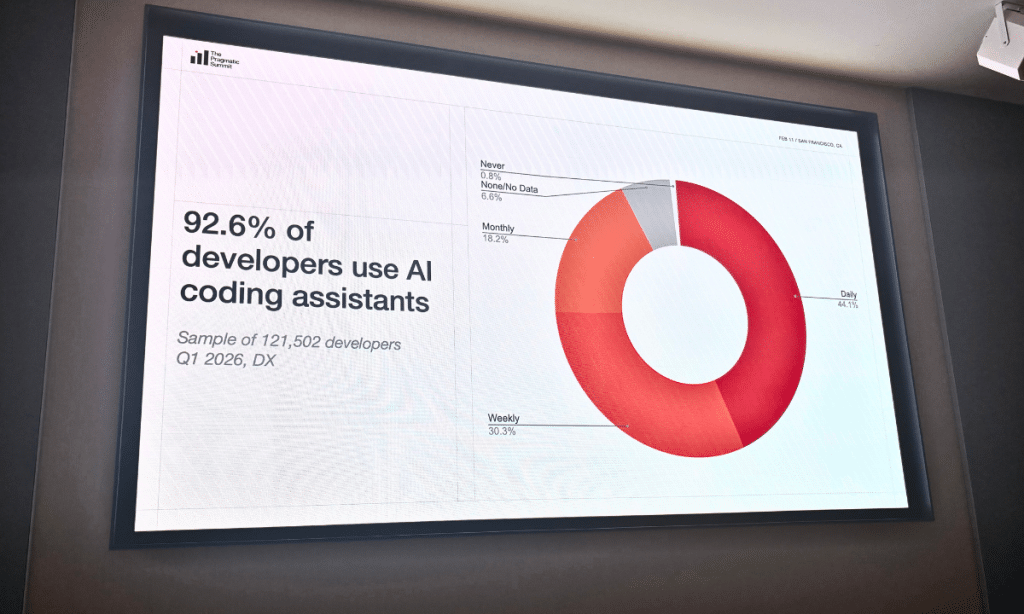
The research surveyed 121.000 developers across 450+ companies. A striking 92.6% of them use an AI coding assistant at least once a month, and roughly 75% use one weekly. Clearly, AI isn’t just a side experiment anymore, it’s part of the workflow.

Here are the top takeaways I found most compelling from Laura’s research.
The 10% productivity plateau
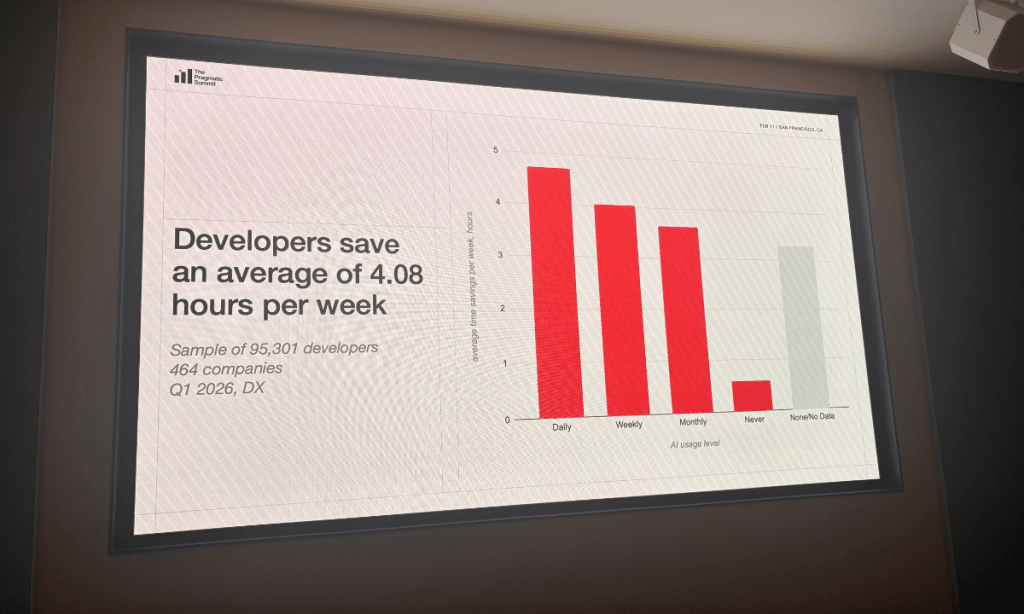
The first thing most people think of with AI assistance is saving time. According to the research, developers say they’re saving about 4 hours a week – pretty much the same as Q2 2025, with Q4 2025 numbers sitting around 3.6-3.7 hours.
It looks like the time-saving boost has leveled off. Productivity shows the same pattern: it jumped around 10% when AI first took off, and since then, it’s stayed steady at that level.
What’s really shifting is the amount of “AI-authored code” – that is, code that gets merged into the main repository or production environment with little to no human intervention. Laura breaks this down using the latest data:
Looking at about 4.2 million developers between November 2025 and February 2026, AI-authored code now makes up 26.9% of all production code – up from 22% last quarter. Daily AI users are also hitting a milestone: nearly a third of the code they merge, which passes review and goes into production, is written by AI.
One example Laura loves to highlight is how AI is speeding up the onboarding process:
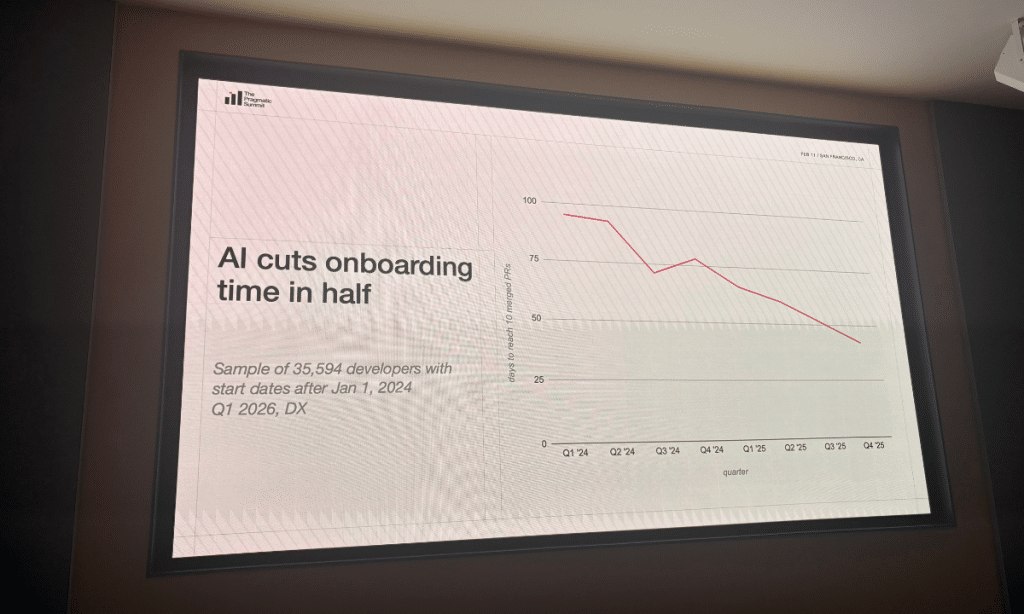
Looking at the data quarter by quarter, from Q1 2024 through Q4 2025, onboarding time has been cut in half. Specifically, we’re measuring it by the “time to the 10th Pull Request (PR).”
This metric (widely seen as a key sign of successful onboarding) has now been cut in half. Because of that, Laura sees AI as a powerful tool for getting people up to speed, whether it’s new hires, engineers switching projects, or even non-engineers stepping into technical workflows.
The faster someone gets up to speed, the longer the productivity boost lasts, usually for at least two years. This points to a bigger trend: AI is helping developers get up to speed faster, reducing mental load, and making it easier to onboard into complex codebases.
In struggling organizations, AI exposes flaws instead of fixing them
Laura also pointed out a part of the research that looks at how AI impacts company performance. This segment analyzed data from 67.000 developers between November 2025 and February 2026, and the findings are strikingly divided.
Some companies are dealing with twice as many customer-facing incidents, while others see a 50% drop.
The difference comes down to how AI is used: in well-structured organizations, AI acts as a “force multiplier,” helping teams move faster, scale with higher quality, and boost reliability. In struggling organizations, AI tends to highlight existing flaws rather than fix them. Based on this, Laura concludes:
Transformation is uncomfortable. Organizations that were ready to quit their cloud or agile transformations are now giving up on AI transformation, too. It’s difficult to look at an entire organization and realize that something fundamental must change to see a real impact on the bottom line.
According to her, adoption alone doesn’t guarantee results, just using the tools doesn’t automatically improve an organization:
This is really a management problem. The hype made it sound like just trying AI would automatically pay off. But so far, most tools have been used for individual coding tasks. To see real impact, we need to use AI at the organizational level, not just for single tasks.
Laura also touched on the most popular AI tools among developers, specifically highlighting Codex:
The Codex desktop app launched on February 2 and has already topped one million downloads, with a 60% growth rate just last week. They recently rolled out GPT-5.3 Codex. Inside OpenAI, 95% of developers use Codex, and those users submit roughly 60% more Pull Requests each week.
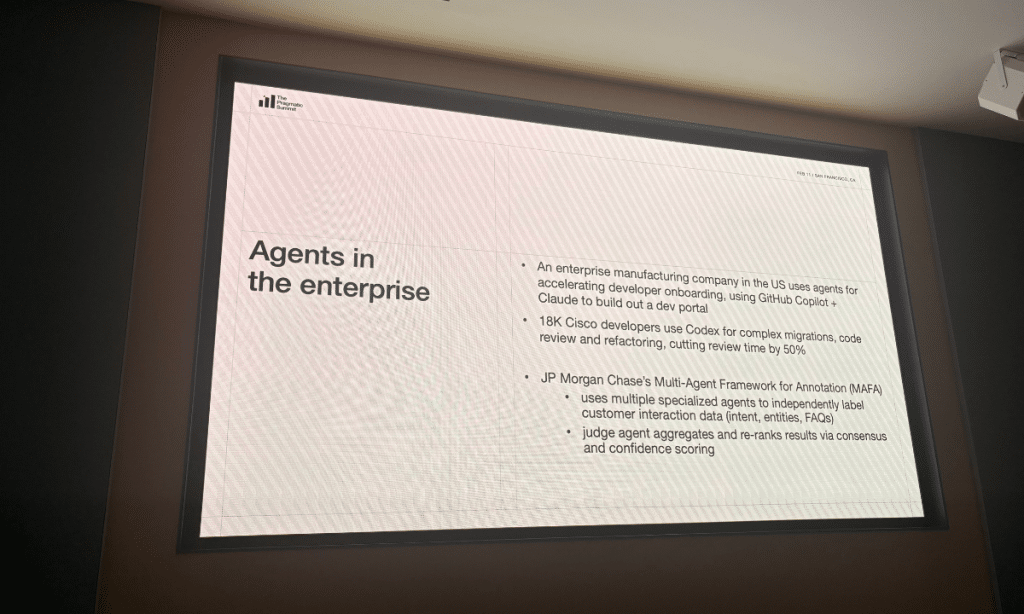
As a real-world example, Laura highlights Cisco, where 18.000 engineers use Codex daily for complex migrations and code reviews. This has cut their code review time in half. But Laura cautions that AI won’t fix deeper organizational issues unless you tackle those problems head-on, and that starts with acknowledging they exist.
Since organizations remain constrained by human and systemic friction, Laura notes:
I am skeptical of any technology’s promise to improve performance without addressing those underlying constraints. If we don’t solve our systemic issues, we’ll just “carry them into space with us.” The real question isn’t how to colonize Mars, but how to achieve actual organizational impact.
DevEx is more important than ever
To wrap things up, Laura revealed the secret to success for those who are “winning” with AI:
1. They set clear goals and measure results.
2. They recognize that Developer Experience (DevEx) matters more than ever.
3. AI succeeds when factors like fast Continuous Integration (CI), clear documentation, and well-defined services are in place.
At the end of the day, getting real organizational results means treating AI as a company-wide challenge. The research shows the barriers aren’t technical, they come down to change management and leadership support. Laura sums it up:
Successful organizations experiment by tackling real customer problems. Exploring Mars sounds exciting, but it’s not sustainable – it’s expensive and distracts from the core business. Focus your experiments on the customer to drive meaningful results. After all, somewhere, something incredible is waiting to be discovered.