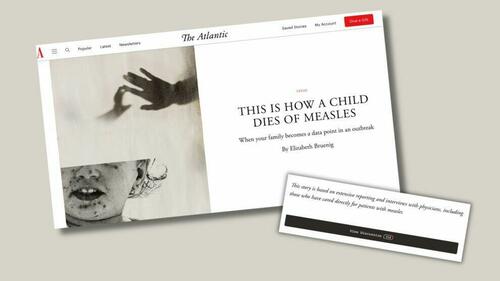
Last Thursday, The Atlantic published a heart-wrenching story about an 11-month-old child who died of measles. Written in the second person from the perspective of a mother whose two unvaccinated children fell ill with the disease, the story is rich with personal detail;
"You plant her on the couch with a blanket and put Bluey on the TV while she drifts in and out of sleep..."
"While the kids are napping, you tap a list of your daughter’s symptoms into Google and find a slew of diseases that more or less match up..."
"Her cough wracks her whole body, rounding her delicate bird shoulders. She does not sleep well. And as you lift up her pajama top to check her rash one morning, you see that her breathing is labored, shadows pooling between her ribs when she sucks in air."

Turns out, NONE OF THAT HAPPENED. The Atlantic's Elizabeth Bruenig simply made it up, leading to mass confusion.

As Laura Hazard Owen of NiemanLab - who initially busted Bruenig - writes:
When I initially read Bruenig’s story, I was stunned: An Atlantic staff writer’s unvaccinated child had died of measles in the 2020s, and now she was writing about it? At the end of Bruenig’s piece, though, there’s an editor’s note: “This story is based on extensive reporting and interviews with physicians, including those who have cared directly for patients with measles.” That was the point when I sent a gift link to my mom group: “as far as I can tell this piece is fiction. What do we think about this choice? I am very conflicted!!!” My conflict stemmed from my concern that, though the piece was heavily researched, it was not a true story. I wondered if the key people whose minds might be changed by it — people who don’t vaccinate their kids — would brush it off as fiction, or fake.
Following the publication, two journalists reached out to Owen to let her know that they were similarly confused, as there "was not an editor's note/disclaimer on the piece at all."
What's more, The Atlantic's own spokesperson told one of the journalists: "This is based on a mother's real account," - after which the outlet added a disclaimer.
The comments section at The Atlantic is full of similarly confused readers:


Of course, some Harvard douche who doesn't disclose that his own work was mentioned in The Atlantic 'immediately recognized the article as hypothetical.' Great job Stuart!
Loading recommendations...