Authored by Mollie Engelhart via The Epoch Times,
Last Sunday, I held a book signing at Pearl in San Antonio, the kind of place magazines love to feature. Old brick buildings have been transformed into beautiful restaurants, boutiques, apartments, and bookstores. It feels curated yet charming, historic yet modern, a vision of how we’re told that cities should look and feel.

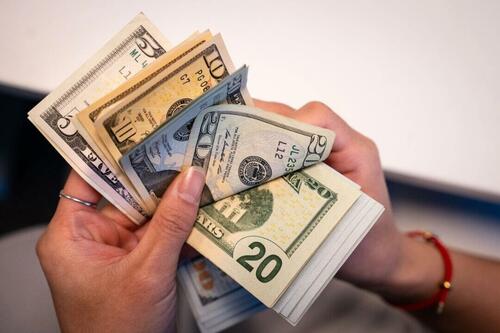
My signing happened during the farmers market, so there was music in the air, families strolling, dogs on leashes, linen dresses, and heirloom tomatoes. It was lovely. Before I sat down, I stopped into the trendy grocery store nearby. Everything inside looked like how food should look: thoughtfully sourced, artfully displayed, and priced closer to what real food actually costs when someone grows it with care. I ordered a coffee and a pastry and pulled a $20 bill from my wallet.
“We don’t take cash,” the cashier said politely.
I nodded. I’ve worked in restaurants, and I understand the argument. With employees, cash can be seen as a liability, with risks of theft, accounting errors, and end-of-day discrepancies. Cards feel cleaner, easier, and more trackable. Still, something in me tightened. Every time we stop accepting cash, we normalize a world where every transaction is recorded, categorized, stored, and potentially scrutinized. Every purchase becomes a data point. Every cup of coffee leaves a digital trail.
I took my coffee, found my seat at the bookstore, and started signing books. Between conversations, I could hear the sizzle and chatter from a nearby empanada booth at the farmers market. The smell of warm pastry finally got me. I walked over, cash already in hand.
“Can I get a potato empanada?” I asked.
The woman at the booth said, with an apologetic smile, “We don’t take cash.”
Not a brick-and-mortar store with layers of management, a pop-up tent at a farmers market. That’s when it really hit me. This isn’t just about convenience or speed at checkout. Cash itself is becoming strange, inconvenient, outdated, and almost suspicious. We’re being trained to accept that every exchange must be mediated, approved, and recorded by a third party, and that third party isn’t free.
Most of the vendors there were using Square to process payments. The typical fee is about 3 percent to 4 percent per transaction. That might not sound like much, but that percentage is shaved off every single time money changes hands digitally.
If I hand $20 in cash to the empanada vendor, and he hands that same $20 to the barber who cuts his hair, and the barber gives it to a babysitter, and the babysitter uses it to buy a pizza, that same $20 bill keeps moving through the community at full value. No one skims anything off the top.
But in the digital system, that cut happens again and again, and the effect compounds. At a 3.5 percent fee, after one transaction, that $20 becomes $19.30. After two, $18.62. After three, $17.97. After four, $17.34. After five digital transactions, only about $16.74 remains in circulation. More than $3 of the original $20 has quietly disappeared in just a handful of everyday exchanges. That money didn’t go to the farmer, the barber, the babysitter, or the pizza shop. It left the community entirely.
It’s a quiet drain on small communities, a friction we barely see because it’s spread out, invisible, and normalized. There’s also a common belief that businesses are required to accept cash because it’s legal tender. The truth is more complicated. In most places, private businesses can choose what forms of payment they accept unless a local or state law says otherwise. So no, they aren’t necessarily breaking the law. But legality and wisdom are not the same thing.
Every digital transaction comes with processing fees and interchange costs. Small businesses quietly lose a percentage of every sale, and customers pay more over time as those costs are baked into prices. In return, we give up privacy, independence, and the simple resilience of being able to transact even when systems go down. Cash works during power outages. Cash works when the internet is down. Cash works without a corporate intermediary. Cash is anonymous, direct, and final.
When everything becomes digital, spending can be tracked, restricted, frozen, or flagged. We may not feel that pressure today when we’re buying coffee and pastries in beautiful spaces, but systems built for convenience can easily become systems of control.
What struck me most that morning was the irony. I was at a farmers market, a place that represents local food, small producers, and community resilience, and yet even there, we’ve accepted the idea that every transaction must flow through the same centralized financial rails. We tell ourselves that it’s about ease, but what we’re really trading is privacy, resilience, and a small but meaningful piece of our sovereignty over how we spend the fruits of our labor.
It happened so gradually that most of us didn’t even notice. Until one day you’re standing at a farmers market, cash in hand, and realize that the future has arrived quietly, and that it doesn’t include the simplest form of freedom we used to carry in our pockets.
Views expressed in this article are opinions of the author and do not necessarily reflect the views of The Epoch Times or ZeroHedge.
Loading recommendations...