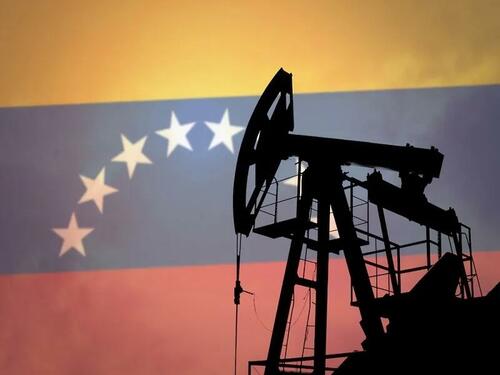
A new US license is being interpreted as prohibiting Venezuelan energy companies from transactions with China among other countries, which if true, could lead to India purchasing the 642,000 barrels of oil per day that China imported on average last year and thus halving its import of Russian oil.

RT drew attention on social media to the Department of the Treasury’s newly issued “Venezuela General License 48” allowing US companies to provide “goods, technology, software, or services for the exploration, development, or production of oil or gas in Venezuela” with two strings attached.
The first one is that any contract that their partners enter into will be governed under the laws of the US, which segues into the second one prohibiting any transactions with Russia, Iran, North Korea, Cuba, and China.
It’s for this reason that RT interpreted the abovementioned license in their tweet as the “US Ban[ning] Venezuelan Oil Producers From Doing Business With Russia & China”.
That’s reasonable since it was explained here that the Trump Doctrine is shaped by Elbridge Colby’s “Strategy of Denial”, which in its simplest form, seeks to deny strategic resources to US rivals such as the previously described countries.
This is especially the case as regards China, the US’ systemic rival, but Trump earlier sent mixed signals.
He recently welcomed Chinese investment in Venezuela’s energy industry, but in retrospect, that might have just been for the sake of managing the Sino-US rivalry amidst their ongoing trade talks.
Trump wants a deal with Xi, which might become much more difficult for his counterpart to agree to if he openly declares his intent for the US to deny China continued access to Venezuela’s strategic resources. It therefore makes sense for the US to quietly implement this policy through its new license instead.
Even prior to its promulgation, Russian Foreign Minister Sergey Lavrov complained that “our companies are being openly forced out of Venezuela”, so this policy was already being informally implemented by Delcy Rodriguez’s government under US pressure. Apart from Cuba, none of the countries that the US’ new license prohibits transactions with are dependent on Venezuelan energy, but cutting them out of this industry serves another purpose arguably even more strategic than denying them its resources.
Trump boasted earlier this month that India agreed to stop purchasing Russian oil as part of the terms of its trade deal with the US and replace its imports with American and possibly Venezuelan oil instead. It was hitherto assessed prior to the US’ new license that “India Is Expected To Only Slowly Reduce Its Import Of Russian Oil” in no small part due to the Venezuelan Ambassador to China confirming his country’s interest in continuing exports to it and Trump welcoming Chinese investment in this industry.
If RT’s interpretation of the license is correct, and Lavrov believes so after complaining about the US’ new prohibition on Venezuelan energy transactions with Russia during his latest appearance at the Duma, then India could purchase the 642,000 barrels per day of oil (bpd) that China imported on average last year.
That’s more than half of the 1 million bpd that India imported from Russia last month, which could lead to a sharp reduction in the budgetary revenue that Russia expected to receive from such sales.
The US is actively monitoring India’s direct and indirect import of Russian oil per the condition under which it recently lifted last summer’s punitive 25% tariff that was imposed because of these dealings.
Therefore, by cutting China out of the Venezuelan energy industry and consequently enabling India to replace its import of that country’s oil, the US is facilitating India’s rapid reduction of Russian oil imports and might even zero it out if this policy is soon replicated with respect to Iran’s oil exports to China.
Loading recommendations...