Submitted By Thomas Kolbe
As the 27 EU heads of government convene with EU Commission President Ursula von der Leyen on Thursday, the stakes are high from a fiscal perspective. A decisive item on the agenda at Belgium’s Alden Biesen Castle is the so-called Draghi Plan.
The question hovering above it all is as simple as it is explosive: How can the obvious productivity and growth weakness of the Eurozone economy be overcome? For years, economic dynamism has lagged behind other major economies, with structural barriers stifling investment and innovation. Over-indebtedness and bureaucratic weight press down like lead on EU economies.

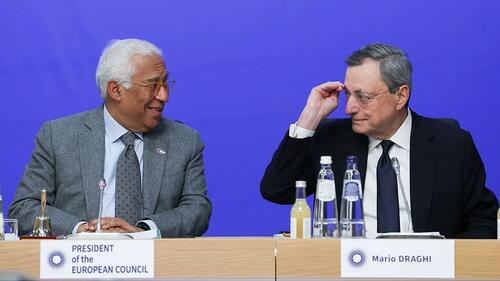
For former ECB President and former Italian Prime Minister Mario Draghi, the answer is clear. He calls for a massive, debt-financed stimulus program to give Europe’s economy a new jolt. The scale and financing of this initiative mark a profound turning point in European financial policy.
It is the hour of the central planners and Euro-bureaucrats. In Alden Biesen, the European Union’s course will be determined – and how it responds to its economic weakness.
Two years ago, Draghi laid out his strategy to strengthen the EU’s competitiveness. In short, Eurozone countries would raise €800 billion annually in joint debt and invest these funds strategically in renewable energy, digitalization, and coordinated European industrial policy. This, he argues, would close the massive competitiveness gap with the US and China. Simply put – EU intellectual processes usually operate on modest ambition.
The Draghi Plan represents a profound paradigm shift. It implies the completion of the Capital Markets Union and the creation of an EU-wide debt pool – precisely the instrument that former Chancellor Helmut Kohl had deemed an absolute red line for abandoning the Deutsche Mark and introducing the euro.
Kohl’s skepticism was not unfounded. For those familiar with the fiscal behavior of countries such as France, Greece, Italy, or Spain, such a step would be nothing short of a sacrilege. It is evident that any national budget politician would rely without hesitation on Germany’s fiscal solidity – which, as we know, has been effectively crucified by Chancellor Friedrich Merz in the past year.
The openly discussed fiscal hubris in the Draghi vein is accompanied by cautiously inserted bureaucratic verbosity. Progressivism and populist appearances aside, it is clear that the EU’s bureaucratic apparatus and its national branches cannot be circumvented – this construct has become the actual power base of politics, its bureaucracy serving as an extended arm and visible presence in the provinces.
The number of regulations issued and interventions in market processes almost defines political power within this structure. Meanwhile, the Union, in the mode of green-transformation central planning, is heading toward economic disaster without the bureaucratic apparatus being in the least affected.
Among the loud proponents of this policy is French President Emmanuel Macron. On Tuesday, he explicitly called for permanent joint borrowing capacities at the EU level.
Macron, a president without a people, whose approval ratings hover around 15 percent, went further than Draghi’s hubris: he demanded funding via the issuance of €1.2 trillion in joint Eurobonds annually. Naturally, these funds would flow into green and digital technologies, as well as the growing European defense complex, to deliver the hoped-for economic breakthrough. Green still seems the color of hope, while European daily life sinks into deep gray.
Macron’s move to another funding level is understandable given his country’s precarious fiscal situation. With public debt over 115 percent and a deficit well above five percent this year, it is practically impossible to overcome the parliamentary deadlock and enforce the minority government supported by President Sébastien Lecornu.
France remains the ungovernable, reform-incapable millstone now thrown around the necks of other Europeans.
Yet it would be unfair to focus solely on France, without noting the enormous fiscal holes in other countries. The Mediterranean problem cannot be solved under the current political design. Countries such as Finland, and especially Belgium, also stagger toward a serious funding crisis of their overstretched welfare states.
EU Europe is far more than just a club of debtors. Within Brussels’ leadership circle, there is consensus to postpone pressing reforms – such as ending the ideological open-borders policy or limiting overstretched welfare states – through new debt and ever higher levies on the middle class.
The debate over introducing a wealth tax in Germany, or raising inheritance taxes on corporate assets, underscores the technocratic mindset of the political class and the intent to shift fiscal burdens onto a shrinking middle class.
With the US stepping back from the phalanx of globalists and central planners, the EU faces pressure: either comply with Washington’s new political strategy – accept deregulation, establish a new border regime, and abandon the civilization-hostile green transformation project – or continue its own course, effectively in a negative fiscal spiral.
The alternative will likely be presented at the EU summit: a “carry on” approach, accelerating the descent down a tilted slope, in the hope of somehow surviving the passage of time.
Europe’s bureaucratic representatives now deliberate over competitiveness – failing to see that their own existence logic and institutional design are the root cause of economic weakness. Macron, von der Leyen, and Merz appear less as actors than as symptoms of a postmodern cultural problem: the rejection of civic values, the erosion of cultural capital, and the disregard for meritocratic principles accelerate the decline of Western economies.
Competitiveness requires more than state investment and financial incentives. It thrives only on a foundation of value-based thinking, stable family structures, and intergenerational responsibility.
Education, diligence, and innovation can only flourish if individual achievement is recognized. Equally crucial are social bonds that transmit knowledge and skills from one generation to the next.
Without this cultural and moral foundation, any polity degenerates into a form of parasitism, most evident in Europe’s growing welfare structures.
The imposition of colossal debts to stabilize the fatal European socialization experiment on future generations constitutes the ethical sin of this policy and will massively accelerate the EU’s decline.
* * *
About the author: Thomas Kolbe, born in 1978 in Neuss/ Germany, is a graduate economist. For over 25 years, he has worked as a journalist and media producer for clients from various industries and business associations. As a publicist, he focuses on economic processes and observes geopolitical events from the perspective of the capital markets. His publications follow a philosophy that focuses on the individual and their right to self-determination
Loading recommendations...