Authored by Gwyn Morgan via The Epoch Times,
Germany was postwar Europe’s greatest economic success story.
Today it is a cautionary tale.
Once the continent’s industrial engine, Germany has spent the past decade dismantling the foundations of its prosperity through energy and immigration policies driven more by ideology than evidence or good sense. The results have been rising costs, falling competitiveness, social disorder, and political backlash.

Canada should study this record closely—because we are pursuing many of the same policies.
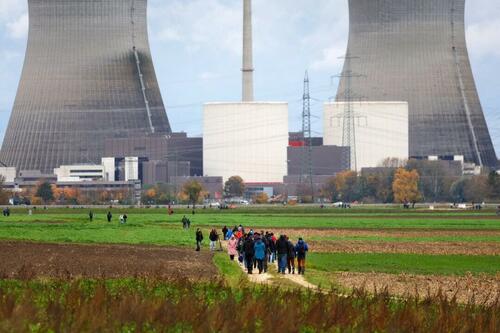
Energy has played a leading role in Germany’s decline. Reliable, affordable power is the lifeblood of any advanced economy. In 2002, Germany’s 11 nuclear power plants supplied more than one-quarter of its electricity, with coal providing most of the remainder and natural gas filling in when needed. “Renewable” energy played only a minor role. The country had a stable, economically efficient grid that supported one of the world’s most productive industrial bases.
That balance was abandoned. Driven by an ideological campaign against nuclear power, successive governments committed to replacing reliable baseload electricity with intermittent wind and solar. The goal shifted from reducing emissions to shutting down all nuclear plants, at any cost. After Japan’s Fukushima disaster in 2011—caused by a tsunami, not reactor failures—Germany accelerated these closures. Within six months, eight nuclear plants were taken offline. The rest would eventually follow. Not even Vladimir Putin’s invasion of Ukraine would throw Germany’s anti-nuclear zealots off-track.
The consequences were predictable. Electricity demand rose as Germany pushed consumers and industry to electrify, but wind and solar output could not keep pace. Germany turned instead to imported natural gas, much of it from Russia, replacing energy independence with geopolitical vulnerability. Had Germany kept its nuclear plants operating, a PricewaterhouseCoopers study concluded, 94 percent of its power generation would now be emissions-free and electricity prices roughly 23 percent lower.
Instead, Germans now face some of the world’s highest electricity prices plus declining reliability. They even coined a new word, “Dunkelflaute,” to describe calm, dark periods when wind and solar produce no power at all. High energy costs have hollowed out German industry. Its world-leading chemicals sector has shrunk dramatically. Family-owned manufacturers—a pillar of German industry for centuries—are closing by the hundreds.
The damage is most visible in Germany’s auto sector, which once provided livelihoods for millions and anchored its export economy. Today it is in retreat. Production fell by 29 percent between 2017 and 2024. Chinese manufacturers—benefiting from scale, subsidies, and lower energy costs—are flooding European markets with affordable electric vehicles. German firms are losing market share and laying off workers in large numbers for the first time since the World War II.
This should sound uncomfortably familiar to Canadians. Canada is also driving up domestic energy costs while betting heavily on electrification and electric-vehicle manufacturing. We have fewer industrial buffers than Germany and higher transportation costs. If Europe’s industrial powerhouse cannot absorb these shocks, Canada’s position is even more precarious.
Germany’s second self-inflicted wound was mass immigration. During the Syrian civil war, Chancellor Angela Merkel opened her country’s borders, blithely declaring “Wir schaffen das” (“We can do this”). By the end of 2015, Germany had taken in 1.2 million refugees. Integration systems were overwhelmed while schools, housing, social services and policing struggled to cope. Despite these clear warning signs, Germany kept right on going, bringing in hundreds of thousands of migrants year after year from troubled Asian and African countries.
The fiscal cost has been staggering. In 2024 alone, Germany spent nearly 30 billion euros, or about C$48 billion, on refugees and asylum-seekers, not including costs associated with crime and security. Social cohesion frayed further. Public spaces required ever-heavier security. Terrorist attacks and sexual assaults rose. Political backlash followed.
Only now is Germany putting on the brakes, deporting tens of thousands of rejected asylum seekers or criminal migrants and cutting benefits.
The same government that once insisted open borders were a moral imperative now acknowledges limits.
Germany’s energy and immigration failures have a common cause: policymaking driven by moralistic certitude rather than empirical recognition of practical constraints. In both cases, dissent was dismissed, costs were minimized, warnings ignored, and course-corrections refused even after damage became impossible to deny.
Canada should take note. We are raising energy prices while maintaining immigration at near-record levels—including hundreds of thousands of barely-if-at-all vetted refugees—amid a housing shortage, stagnant productivity, and strained public services. Germany shows how quickly good intentions can morph into economic and social decline.
Canada still has time to change course. Whether we choose to learn the lesson is another matter.
* * *
Gwyn Morgan devoted three decades to building North America’s leading oil and gas company. He has served as a director of five global corporations, and was appointed a Member of the Order of Canada in 2011.
The original, full-length version of this article was recently published in C2C Journal.
Views expressed in this article are opinions of the author and do not necessarily reflect the views of The Epoch Times or ZeroHedge.
Loading recommendations...