Summary
Iranian sources to Chinese state media says 'breakthrough' toward restarting US talks again could come 'tonight or tomorrow'.
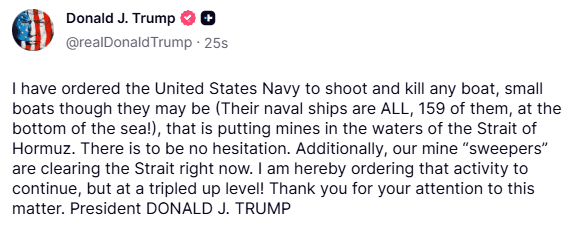
Trump orders US Navy 'shoot & kill' small Iranian boats amid concern over mines in Hormuz.
Overnight, US military intercepted two more Iranian oil supertankers that tried to evade the blockade And in Indian Ocean US conducted a maritime interdiction and right-of-visit boarding of the sanctioned stateless vessel M/T Majestic X transporting oil from Iran.
Media sources confirm based on prior Trump post that US has extended the ceasefire indefinitely until 'unified proposal' can be brought forward by Tehran.
Yes 56% · No 44%
View full market & trade on Polymarket
* * *
Trump Orders Navy to Shoot & Kill
Despite a ceasefire still technically being on, President Trump has just ordered the US Navy to "shoot and kill" any small Iranian boat which poses a threat to the Strait of Hormuz, especially ones "putting mines in the waters" of the strait. This risks rapid escalation already amid tit-for-tat tanker seizures, and it means a shooting war could soon open up in the contested vital waterway.

Oil, and markets reacted immediately on the escalatory order from Washington:

Status of Stalled Pakistan Negotiations: 'Breakthrough' Soon?
US hours began with a somewhat optimistic headline, picked up by Reuters, which was strangely enough first issued by Chinese media. Iranian sources said preparations for Iran-US negotiations could produce a breakthrough "tonight or tomorrow," according to Chinese state broadcaster CCTV. However, this supposed 'breakthrough' speaks to merely getting to the table, which last weekend the sides failed to do in what was the planned, but canceled, second round.
Meanwhile a reported Pakistani proposal calls for reopening the Strait of Hormuz in exchange for a partial lifting of sanctions on Iran.
Pakistani officials blamed the US blockade, not internal divisions in Iran, for the stalled talks, while President Trump apparently having extended the ceasefire indefinitely, citing what he described as "fractured" leadership in Tehran.
Trump has extended the ceasefire indefinitely. From a Tuesday Truth Social Post: "Based on the fact that the Government of Iran is seriously fractured, not unexpectedly so and, upon the request of Field Marshal Asim Munir, and Prime Minister Shehbaz Sharif, of Pakistan, we have been asked to hold our Attack on the Country of Iran until such time as their leaders and representatives can come up with a unified proposal."
Another US Boarding... in Indian Ocean
US forces conducted "a maritime interdiction and right-of-visit boarding of the sanctioned stateless vessel M/T Majestic X transporting oil from Iran in the Indian Ocean" overnight, the US Department of Defense said on X.
The statement said the vessel was operating within the area of responsibility of United States Indo-Pacific Command. "We will continue global maritime enforcement to disrupt illicit networks and interdict vessels providing material support to Iran, wherever they operate," it said. "International waters cannot be used as a shield by sanctioned actors. The Department of War will continue to deny illicit actors and their vessels freedom of maneuver in the maritime domain."
The interdiction video put out by US Central Command:
Latest Hormuz Intercepts
The Hormuz chokepoint standoff between Tehran and the US military has become the center of the nearly two-month conflict. This standoff marks the next phase following an extended ceasefire with Iran after a second round of peace talks was canceled in Pakistan earlier this week.
On Wednesday, White House Press Secretary Karoline Leavitt said President Donald Trump is allowing Iran more time to respond to US demands, but expects Tehran to present a "unified proposal."
"So, again, the president's offering them a little bit of flexibility because we want to see a unified proposal to the president's very strong proposal. And he's made his red lines very clear," Leavitt said.
Iran has stated that it will not resume negotiations with US officials while a US naval blockade on its ports remains in place, and the US military said it intercepted two Iranian oil supertankers that tried to evade the blockade.
This comes after Iranian forces seized two ships on Wednesday.
In response to Trump's ceasefire extension, Iran's state TV cited the foreign ministry as saying it is monitoring developments and that the armed forces are ready for any threat.
With Hormuz effectively shut this week, roughly a fifth of global oil and LNG flows remain highly disrupted as the energy shock ripples from the Middle East to Asia, Africa, Europe, and finally the West Coast of the US.
A new Department of War assessment cited by The Washington Post said it would take US forces six months to clear the maritime chokepoint of mines deployed by Iranian naval forces.
Other overnight news includes Pentagon spokesperson Sean Parnell announcing that Secretary John C. Phelan will be stepping down. "On behalf of the Secretary of War and Deputy Secretary of War, we are grateful to Secretary Phelan for his service to the Department and the United States Navy," Parnell said in a statement. "We wish him well in his future endeavors."
Latest overnight headlines (courtesy of Bloomberg):
Ceasefire Extension
US President Donald Trump extended a ceasefire with Iran indefinitely on Tuesday evening with no deadline for its expiry
Iran has said it will not resume negotiations while a US naval blockade on its port remains in place
Vice President JD Vance had been prepared to fly to Islamabad for peace talks, but Tehran says it has no plans to take part in negotiations imminently
Hormuz
Traffic through the Strait of Hormuz ground to a halt on Thursday after Iran fired on commercial ships and seized at least two vessels
Iran's Islamic Revolutionary Guard Corps seized the MSC Francesca and another ship identified as 'Epaminondes' on Wednesday
Iran has collected its first revenue from tolls imposed on the Strait of Hormuz, according to an Iranian lawmaker
Blockade
The US military intercepted two Iranian oil supertankers Hedy and Hero II that tried to evade its blockade earlier this week
At least two fully laden Iranian tankers sailed past a US blockade this week, ferrying roughly 9 million barrels of oil to market
Iranian gunboats fired on commercial ships in the Strait of Hormuz on Wednesday while two of its own oil supertankers tested the US blockade
Market Impacts
Energy prices are rising again due to the impasse and worsening tension over the Strait of Hormuz
Emirates is operating at 65% of capacity with about 13% of airports in its network still cut off
Honeywell's outlook assumes the conflict will last through the second quarter and decrease revenue by about $100 million to $150 million
Sweden may need to restrict energy use if supplies from the Middle East remain disrupted, with the government examining potential limits on fuel use
Chart of the Day (via UBS)

Commentary on energy markets from UBS analyst Catherine Gordon:
The UBS oil & gas team continues to argue the scale of disruption is underpriced in both oil and equities: the UBS base case had de-escalation in early April and gradual resumption of flows over 2Q26, keeping Brent at $100/bbl in 2Q26 and in the low to mid-$80s in 2H26, but this path requires actual improvements in flows very soon, rather than only a ceasefire.
Absent progress toward normalizing energy flows via the Strait of Hormuz within the next week or two, UBS warns the market risks a significant spike in oil and LNG prices, with longer disruption into May breaching recent highs of ~$120/bbl for front month and ~$150/bbl for Dated Brent.
Energy‑dedicated investors continue to focus on barrels versus rhetoric: each day of stalemate implies a forfeiture of roughly 12–15mb/d of production. The market is now moving into an energy “air pocket,” which should drive a convergence between dated and forward oil prices, or between divergent price expectations in the physical and paper energy markets.
From a trading perspective, broader equities have remained resilient on “de‑escalation” headlines, but the setup still feels very fragile, with technicals having done much of the work (CTAs slowing), positioning has caught up, and index‑level valuations are pricing in relatively little disruption.
Brent crude futures are trading at $103 a barrel.

*This is the running blog of the US-Iran conflict for Thursday.