Submitted By Peter Tchir of Academy Securities
This week’s market behavior had a mythical, almost magical tone to it.
In Arabian Nights, Ali Baba was able to open a cave of riches by uttering the phrase “Open Sesame.” Markets responded to any and every sort of connotation of “The Strait is Open” by rewarding participants with riches. We started this week bright and early, kicking off Bloomberg TV, and then moving on to Bloomberg Radio, and Tom Keene’s Best Ideas.
At the time we were all trying to understand what “Blockade” meant. How and what was the U.S. going to do in terms of a blockade? Markets were jittery, but somehow, from almost the get go, markets seemed to take the combination of U.S. and Iranian snippets to mean the Strait was Open.
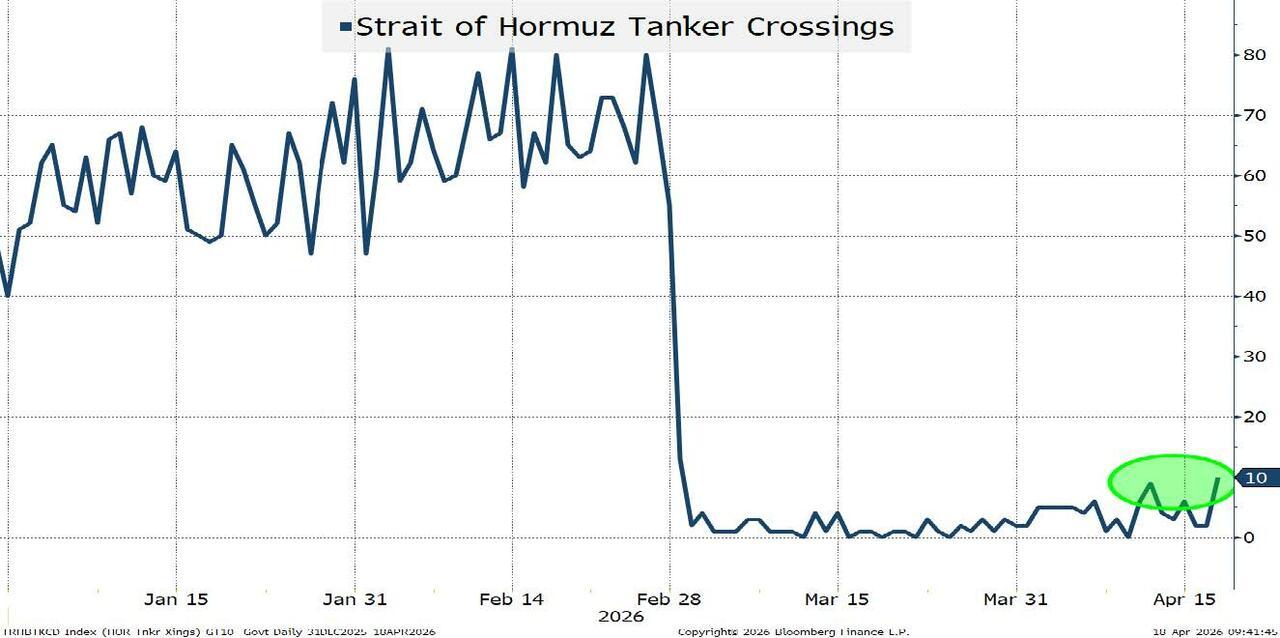
I am not sure how accurate this data set on Bloomberg is (TRHBTKCD index) given all the conflicting stories of what has transited or not, what is running without transponders, etc. But traffic remains subdued.

We have argued that a ceasefire benefited the U.S. more than Iran and that there were some very strong possible outcomes from U.S. efforts in the region. I underestimated how quickly and how big those good outcomes would be reflected in the market.
While “any option” still seemed viable, markets had moved on to not only is a deal close, but it will also be the best possible deal. A deal where Iran not only stops pursuing a nuclear weapon, but they would also provide the U.S. with all of their enhanced uranium.
As the weekend progresses, it is unclear how realistic this type of deal is. There are once again competing narratives about the Strait.
Weirdly, unless you are trading futures, you can skip the “green dot” Sunday night, as time and again, the Sunday night price action has done little to predict how markets would behave once the U.S. opens.
Just How Magical Was “Open Sesame”?
Last weekend, we went with More Than Just Iran. Academy had delivered so much content on Iran, that we wanted to highlight some of the other issues (and opportunities) facing the market.
Software.

Software conclusion – Problem Solved.
IGV (software ETF) rose 14% on the week. ARKK which I use as a “proxy” for disruption, also rallied by 15%. INTC (one of the few individual tickers I’ve been vocal about in reports and the media) said “hold my beer” as it rallied 35% in less than 2 weeks! QTUM (quantum ETF) was up 25% and didn’t sell off as much in the first place – which makes some sense as investment into this area is only increasing.
Private Credit.

While the rebound hasn’t been as strong in private credit (and private credit-related companies) it started to rebound earlier. We liked it “for a trade” as it had seemed to be oversold and was trading “ok” even when bad news hit the tape.
We use BIZD to reflect BDCs more broadly. It has risen “only” 9% since April 1st and despite the rally is still below its post-Liberation Day lows.
GPZ (which has seen AUM pop from just over $100 million when we first mentioned it, to over $250 million, predominantly through inflows) is an ETF that I use to highlight the performance of “alternative asset managers” which includes companies with heavy exposure to private credit. It hit the low back on March 12th, and is up almost 20% since then.
OWL, which has arguably been at the epicenter of the Private Credit discussion, rose 20% in just a week as it put its low in just last Friday.
Private Credit. While not “solved,” this market has been stabilizing for some time. Yes it was propelled higher last week, along with almost everything else, but that seemed to be only “part of the story.”
Rare Earths, Critical Minerals, and Uranium.

This one “confuses” me a little bit more than some of the others. Presumably, the war was going to lead to some sort of slowdown and would decrease the need for rare earths (REMX) and Uranium-related companies (URA). Maybe, but war, and more importantly, the replenishment of arsenals, probably isn’t that bad for rare earths and critical minerals.
On uranium, I guess the case could have been made about slowing global demand, but I’m really not sure why an oil shortage was bad for nuclear. One seemingly logical conclusion is that oil, once again highlighting geopolitical risk associated with it, would spur investment into nuclear. It didn’t seem to do that. I’m not sure why Iran handing over enriched uranium and possibly creating a lower risk environment in the Middle East is so good for uranium? I’m long, but can’t really say I understood the price action for the past few weeks.
Rare Earths, Critical Minerals, and Uranium. I guess the “problem” was “solved” but not sure why there was a problem in the first place?
Treasuries

The Treasury market started performing better a few weeks ago and that has continued. We argued that while the initial response to the war would be higher yields, that had become overdone. Now the 10-year has hit our “target” of 4.25%. Our target is for 4.25% on 10s to be the midpoint of the range. If anything, that range might need to be moved lower.
The market is pricing in slightly better than a 50/50 chance of 1 cut this year. While the affordability issue (the way most non-economists now see inflation) will make it difficult to cut, I think the market will have to start pricing in at least one cut ahead of the midterms.
Treasuries. A problem, which was overdone, no longer seems to be a problem, which makes sense.
Bottom Line
Dog-years represent roughly what a dog’s age would be if it was human.
Market participants need to define Trump-years. There has been no slowing of news flow. I see no reason why that would change. In fact, if Iran starts taking up less of the administration’s time, look for the pace of headlines impacting other sectors, relationships, countries, trade, production, jobs, etc. to increase. It seems that I should be able to weave in One Thousand and One Nights into this section, as it fits the Ali Baba and the 40 Thieves theme, but I couldn’t figure out a clever way to do it. It has been a long week! A long month! And even a long year! (Is that the Friend’s theme song?)
Look for lower yields (that seems slightly contrarian here, I think).
I continue to be “pound the table” loud in favor of being heavily overweight the ProSec themes.
I was nowhere near as optimistic on the broad stock market rally as I should have been. Even today, with the benefit of hindsight, it still seems a bit “magical” (or “mechanical”) how well markets behaved in light of the actual headlines. Not the perception of headlines, but the actual headlines. The “Open Sesame” magic that “solved all problems” makes some sense, but positioning may have played a much larger role than we’d like to admit. The faux liquidity of the current trading environment seems to amplify moves.
Let’s hope markets are right and we are near the end. (The exact phrase we used in last weekend’s report).
Things almost seem “too good to be true” but as of now the ceasefire remains intact and other headwinds are being addressed/resolved/ignored which supports the market.
My biggest fears for the economy and risk markets remain affordability, jobs, and the “working poor.” That fear is why I continue to think yields drift lower.