The FaceBook currently known as Meta for one failed venture that incinerated nearly $100 billion in cash for its failed transformation to a virtual reality hub while laying off thousands, is at it again.
As we previewed a few weeks ago, Meta - which inexplicably hasn't changed its name to AIbook yet - will proceed with the first wave of mass layoffs planned for this year on May 20, with more coming later, Reuters reported citing sources.
The Facebook and Instagram owner will lay off about 10% of its global workforce, or close to 8,000 employees, in that initial round, as it swaps headcount for GPUs.
And that's just the start: the company is planning further layoffs in the second half of the year, although details of those cuts, including date and size, have yet to be determined and will depend on just how much more money Meta burns in its experiment to prove that AI will actually generate positive cash flow.
Last month, Reuters reported that the company was planning to lay off 20% or more of its global workforce.
Meta's layoffs this year will be the social media giant's most significant since a restructuring in late 2022 and early 2023 that it dubbed the "year of efficiency," when it eliminated about 21,000 jobs. At that time, Meta's stock was in freefall and the company was struggling to correct for COVID-era growth assumptions that ultimately proved unsustainable. It will soon find itself in the same hole again.
The Menlo Park-based company employed nearly 79,000 people as of December 31.
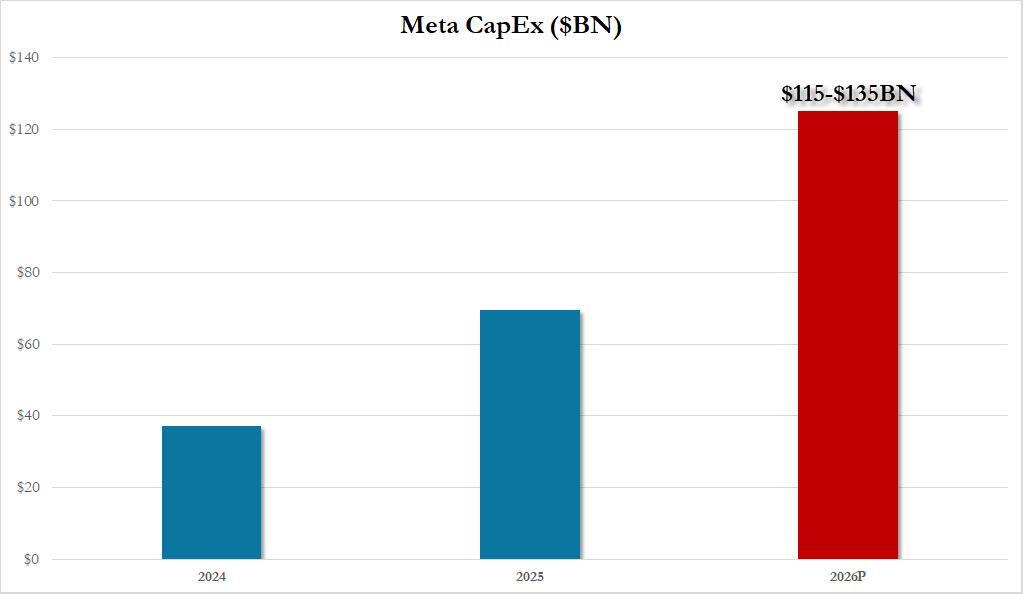
CEO Mark Zuckerberg has been pumping hundreds of billions of dollars into AI as he seeks to dramatically reshape his company’s core business around the technology, which has yet to generate any material returns proportional to the massive capex spend. In its latest earnings call, META raised its 2026 capex guidance to a record $115-$135 billion, more than double the prior years, and drastically more than anything META spent during the peak of its virtual reality phase.

Meta is not alone: Amazonrecently trimmed 30,000 corporate employees, representing nearly 10% of its white-collar workers, while in February the fintech company Block fired nearly half of its staff. In both of those cases, executives tied the cuts to efficiency gains from artificial intelligence. Of course, nobody actually think how mass layoffs of the best paid job in the US - Information - will impact end demand for AI if in a few years, America's (formerly) best paid workers are struggling to pay their San Fran rent, let alone pay for the latest chatbot du jour.
Layoffs.fyi, a website tracking tech job cuts around the world, reported that 73,212 employees have lost their jobs so far this year. For all of 2024, the figure was 153,000.

While META is in a more comfortable financial position now than it was during the 2022/23 purges, executives envision a future of fewer management layers and greater efficiency brought about by AI-assisted workers. Assuming of course the AI bubble doesn't burst sooner as the market realizes the trillions in spending promises by the likes of OpenAI will never materialize.
Meta's shares are up 3.68% since the start of the year, although they are down from a record high achieved last summer. Last year, it generated more than $200 billion of revenue and achieved a $60 billion profit despite outsized spending on artificial intelligence.
In a rerun of its catastrophic foray into virtual reality, in recent weeks, Meta has reorganized teams in its Reality Labs division and transferred engineers from throughout the company into a new “Applied AI” organization tasked with accelerating the development of AI agents that can write code and carry out complex tasks autonomously; expect this to pivot into whatever the AI buzzword of the day is.