An experimental conservation project that was abandoned and almost forgotten about, has ended up producing an amazing ecological win nearly two decades after it was dreamt up.
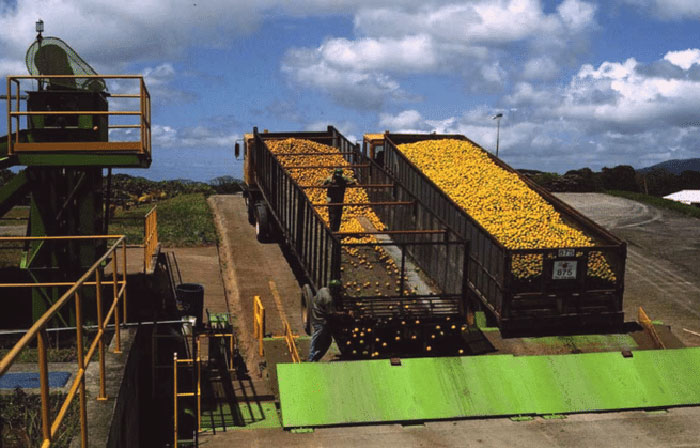
The plan, which saw a juice company dump 1,000 truckloads of waste orange peel in a barren pasture in Costa Rica back in the mid 1990s, has eventually revitalised the desolate site into a thriving, lush forest.
That's one heck of a turnaround, especially since the project was forced to close in only its second year – but despite the early cancellation, the peel already deposited on the 3-hectare (7-acre) site led to a 176 percent increase in above-ground biomass.
"This is one of the only instances I've ever heard of where you can have cost-negative carbon sequestration," says ecologist Timothy Treuer from Princeton University.
"It's not just a win-win between the company and the local park – it's a win for everyone."
 Daniel Janzen & Winnie Hallwachs
The plan was born in 1997 when Princeton researchers Daniel Janzen and Winnie Hallwachs approached Costa Rican orange juice manufacturer Del Oro with a unique opportunity.
If Del Oro agreed to donate part of its land bordering the Guanacaste Conservation Area to the national park, the company would be allowed to dump its discarded orange peel at no cost on degraded land in the park.
The juice company agreed to the deal, and some 12,000 tonnes of waste orange peel carried by a convoy of 1,000 truckloads was unceremoniously dumped on virtually lifeless soils at the site.
The deluge of nutrient-rich organic waste had an almost instantaneous effect on the fertility of the land.
"[W]ithin about six months the orange peels had been converted from orange peels into this thick black loamy soil," Treuer told Scientific American.
"Kind of passing through this gross stage in between of kind of sludgy stuff filled with fly larvae."
 Daniel Janzen & Winnie Hallwachs
Despite this promising start, the conservation experiment wasn't to last, after a rival juice manufacturer called TicoFruit sued Del Oro, alleging that its competitor had "defiled a national park".
Costa Rica's Supreme Court sided with TicoFruit, and the ambitious experiment was forced to end, which saw the site largely forgotten about for the next 15 years.
Then, in 2013, Treuer decided to evaluate the site while visiting Costa Rica for other research.
It turns out, the only problem was actually finding the former wasteland – a challenge that necessitated two trips to the site, given the arid landscape had been unrecognisably transformed into a dense, vine-filled jungle.
"It didn't help that the six-foot-long sign with bright yellow lettering marking the site was so overgrown with vines that we literally didn't find it until years later," Treuer told Marlene Cimons at Popular Science, "after dozens and dozens of site visits."
 Daniel Janzen & Winnie Hallwachs
When comparing the site to a nearby control area that hadn't been treated with orange peels, Treuer's team found their experimental compost heap yielded richer soil, more tree biomass, and a broader diversity of tree species – including a fig tree so huge it would take three people wrapping their arms around the trunk to cover the circumference.
As for how the orange peels were able to regenerate the site so effectively in just 16 years of isolation, nobody's entirely sure.
"That's the million dollar question that we don't yet have the answer to," Treuer told Popular Science.
"I strongly suspect that it was some synergy between suppression of the invasive grass and rejuvenation of heavily degraded soils."
While the exact mechanisms remain something of a mystery for now, the researchers hope that the remarkable success of this abandoned, 16-year-old orange peel dump will inspire other similar conservation projects.
Especially since, in addition to the double-win of dealing with waste and revitalising barren landscapes, richer woodlands also sequester greater amounts of carbon from the atmosphere – meaning little plots of regenerated land like this could ultimately help save the planet.
"It's a shame where we live in a world with nutrient-limited degraded ecosystems and also nutrient-rich waste streams. We'd like to see those things come together a little bit," Treuer told Scientific American.
"That's not licence for any agricultural company to just start dumping their waste products on protected areas, but it does mean that [we] should start thinking about ways to do thoughtful experimentation to see if in their particular system they can have similar win-win-win results."
The findings are reported in Restoration Ecology.